How I Plan a Ten-Book Series
Why ten books
Ten books is long enough to tell a complete story with real growth, short enough that each book still matters. At around 20,000 words per book, the full series is roughly the length of two adult novels. That is a lot of reading for a middle grader, but each individual book is something they can finish in a few sittings.
The three-act structure scales up
A single book has three acts. A ten-book series has three acts too, just bigger.
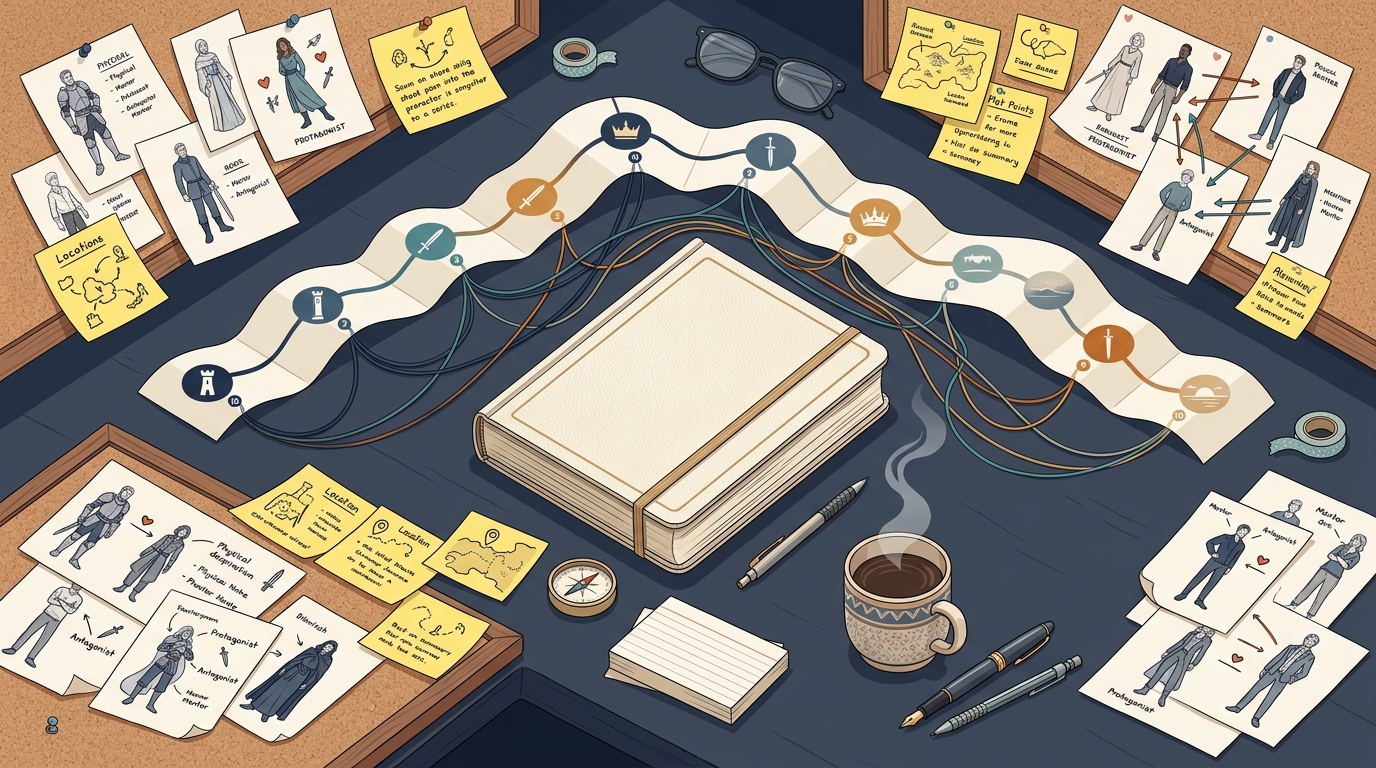
Books 1-3 establish the world, the characters, and the core conflict. Books 4-7 escalate the stakes and complicate everything. Books 8-10 resolve the main arc and pay off every setup.
Within that structure, each individual book also has its own three-act arc. The reader gets a satisfying ending every time while the larger story keeps pulling them forward.
Every book needs its own hook
A series where book four only exists to bridge books three and five will lose readers at book four. Every single book needs its own premise that would make someone want to read it even without the series context.
Beast Rank book four, Evolution Storm, has its own hook: every beast in the academy evolves at the same time. That is interesting on its own. The fact that it advances the larger plot about Pudge's true nature is a bonus.
The character arc outpaces the plot
In the outline phase, I plan the character arc before the plot. The question is never "what happens in book six?" It is "who is Zara in book six, and how is she different from book one?"
Plot events exist to create the pressure that forces character change. Not the other way around.
Planting and paying off
A ten-book series gives you room to plant details early and pay them off late. A throwaway line in book two can become a critical plot point in book nine. Readers love this. It rewards them for paying attention.
I track every plant and payoff in the series bible. Nothing gets planted without a planned payoff, and nothing gets paid off without a setup.
The revision pass
After all ten outlines exist, I do a revision pass across the whole series. I look for pacing issues, plot holes, character inconsistencies, and missed opportunities for connections between books.
This is where the series becomes a series instead of ten separate books. It is the most time-intensive part of planning, but it is what makes the final product feel intentional.