Chapter 1: Tier Three
The glasses buzz before first period.
I’m at my table in the library – third from the back, left side, same seat as always – when the HUD flickers and goes dark. Not off. Dark. The kind of dark that means something is loading underneath.
Three seconds. Five. Diego glances at me from across the table, but I shake my head. Not now.
The screen comes back. And the school is a web.
Lines. Threads. Hundreds of them, glowing faintly in the HUD overlay like a spider’s work made visible. Every student in the library is connected to every other student by thin, shimmering strands – some bright, some barely there, some so thick they pulse with light. The threads radiate outward from each person, linking them to friends, classmates, acquaintances. Social connections. The entire school’s relationship map, rendered in luminous geometry.
I’ve never seen anything like it.
[SYSTEM] TIER THREE INTERFACE – ACTIVE. NEW OVERLAY: SOCIAL WEB.
Social connections mapped: 412 players. Total active threads: 8,247. Average connections per player: 20.1.
Your connections: 4. Classification: HIGH-VALUE NETWORK. VULNERABILITY: CONCENTRATED.
Four threads radiate from my position. Four. In a school where the average player has twenty connections, I have four.
Diego’s thread is the brightest – thick, warm, pulsing with the energy of someone who talks to me every single day whether I want him to or not. Eunji’s is precise and steady, a clean line that doesn’t waver. Marcus’s is broad, the thread equivalent of his shoulders – solid, protective, wider than it needs to be.
The fourth thread is faint. Almost invisible. It stretches toward the far side of the library and connects to a figure I can barely see through the stacks.
Kai Nakamura.
I didn’t choose that connection. The HUD assigned it based on interaction frequency – the confrontations, the parallel operations, the silent acknowledgments between two Phantoms who see the same school through the same glasses. The game decided we’re connected. Whether we like it or not.
I look at the web surrounding the popular kids near the front of the library. Brianna Chen has forty-seven threads. Tyler Morrison has thirty-nine. Their networks sprawl outward like root systems, tangled and vast and diffuse. If you cut one thread, they’d barely notice. They have dozens of backup connections, dozens of people who’d fill the gap.
My four threads are everything I have.
“You’re making a face,” Diego says. “Your I-just-learned-something-terrifying face. Which is different from your I-just-learned-something-interesting face because your left eyebrow does this tiny–”
“Social web,” I say. “The HUD can see social connections.”
Diego sits up straighter. “Like, who’s friends with who?”
“Like who talks to whom, who influences whom, who trusts whom. Every relationship in the school, mapped as threads.”
“That’s…” Diego trails off. For once, he doesn’t have a word. Then: “That’s invasive. Even for the game.”
He’s right. The sight cones were surveillance. The sound radii were measurement. The probability arcs were prediction. But this – mapping every friendship, every alliance, every fragile human connection between four hundred kids – this is something else. This is the game looking at people not as targets but as networks. As systems to be understood, manipulated, or dismantled.
They’re already here when I look up from the web. All three. I was so absorbed in the overlay that I didn’t register their arrivals, which is either a sign of how distracted I am or how quietly Marcus can move when he wants to.
Eunji has her notebook open to a fresh page. She’s been writing since before I noticed her – half the page is filled with her small, precise handwriting, and she’s drawing what looks like a network diagram.
“Social mapping,” she says, without looking up. Flat. Clinical. Like she’s reading a menu. “The game is tracking interpersonal relationships.”
“You’ve been doing that since fifth grade,” Diego says from the chair beside her, feet up, arms crossed. “With a notebook.”
“The notebook doesn’t weaponize the data.” Eunji adjusts her glasses. Her real glasses, not the HUD. “The game will.”
Marcus has arranged three granola bars on the table in a neat row. He’s watching my face with the quiet focus that means he’s already read the room and decided something is wrong.
“Bad morning,” he says. Not a question.
“The game can see friendships now,” I say.
Marcus processes this. His expression shifts from concerned to protective in about half a second. “Can it break them?”
Nobody answers. Because the answer is forming on my HUD right now, scrolling into view like a sentence being typed by someone who wants me to read every word.
I spend the morning watching the web.
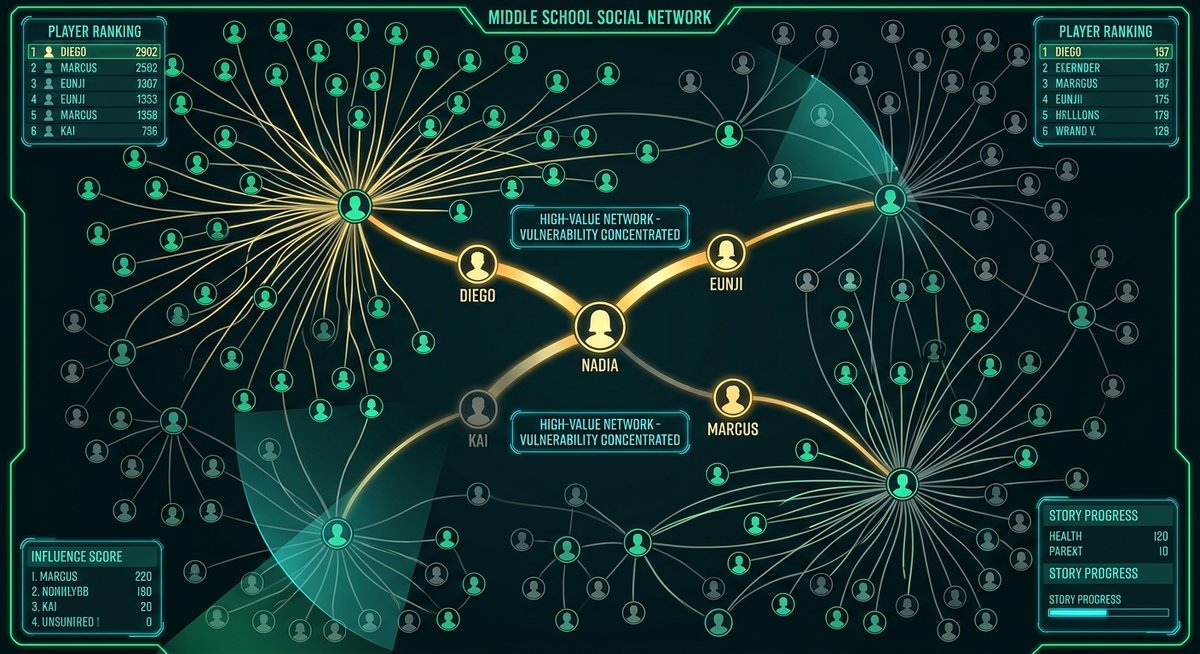
In the hallway between second and third period, I stand against the lockers and watch the threads flow. Students pass in clusters, their connections visible as moving constellations. Friend groups travel together, their threads tight and bright. Acquaintances cross paths and their thinner threads flicker with brief energy. Strangers pass without connection, their icons floating free in the web like untethered satellites.
The web is beautiful. And it’s terrifying.
Because I can see the vulnerable ones. The kids with three connections, two connections, one. The ones whose threads are thin and flickering, whose networks are fragile, whose social existence hangs by strands so fine they could snap in a strong wind.
I can see them because I am them. Four connections. High-value, concentrated, vulnerable.
During lunch, I test the new overlay. I focus on a cluster of eighth graders at the popular table – Brianna’s group, forty-plus connections each, threads radiating outward like they’re the center of the universe. The HUD highlights their network structure: redundant, resilient, interconnected. You could sever five of Brianna’s threads and she’d barely notice. Her social architecture is built for durability.
Then I look at a kid I’ve never really noticed before. Priya Desai, sitting at the edge of a table with three other girls. The HUD shows eight connections. Not bad – twice my count. But the threads are thin. Fragile. Priya’s network isn’t deep. It’s surface-level connections, the kind that evaporate when someone more interesting walks by.
I watch one of Priya’s threads flicker as the girl next to her turns to talk to someone else. The thread dims. It doesn’t break, but it weakens, and the HUD flags it with a tiny indicator I’ve never seen before: ATTENTION DRIFT.
The game is measuring how much people care about each other. And it’s doing it in real time.
After lunch, the notification drops.
I’m in the east wing corridor, heading to science, when the HUD flashes.
[SYSTEM] TIER THREE – NEW MECHANIC UNLOCKED.
SOCIAL ELIMINATION: A player can be eliminated by severing ALL social connections within 48 hours. Method: Targeted social isolation. No physical tag required.
Elimination criteria: Zero active social threads for a continuous period of 4 hours.
I stop walking. A kid bumps into me from behind, mutters “sorry,” and keeps going. I don’t notice. I’m reading the notification again. And again.
Social elimination. The game just created a way to eliminate players without touching them. Without getting close. Without stealth, without sight cones, without any of the mechanics that made the game a stealth game.
You can now eliminate someone by making them lonely.
Cut their connections. Turn their friends away. Empty their lunch table. Make them sit alone, walk alone, exist alone for long enough that the HUD registers zero social threads. And they’re out.
They’d never know they were targeted. They’d just know that for two days, nobody talked to them. Nobody sat with them. Nobody cared. And the game would log it as an elimination – clinical, clean, invisible. The cruelest tag in the game’s history, and the target would feel every second of it without understanding why.
I think about Priya Desai and her eight fragile threads. I think about the kids with two connections, one connection. I think about myself, with four threads that are everything I have.
The game just weaponized loneliness.
And I know – with the cold certainty of someone who has been lonely her entire life – exactly how effective that weapon can be.
I find Diego between classes. He’s leaning against the trophy case outside the gym, watching students flow past, his attention heat map doing its work. He’s always watching, even when he looks like he’s just hanging out. It’s why he’s good at distractions. He sees where attention goes before he redirects it.
“Social elimination,” I say.
Diego’s face changes. Not dramatically – this is subtle Diego, the one that exists behind the performances. His jaw tightens. His eyes narrow.
“They can eliminate people by cutting their friendships?”
“All connections severed within forty-eight hours. Zero threads for four continuous hours. Done.”
“That’s not a game mechanic.” Diego pushes off the trophy case. “That’s cruelty.”
I nod. Because he’s right. The sight cones, the stealth runs, the elimination tags – those were a game. A dangerous game, an invasive game, but a game with rules that operated in the physical world. You got tagged, you were out. Clean.
This is different. This operates in the emotional world. And the emotional world doesn’t have concealment ratings or ghost paths or shadow zones where you can hide from what it does to you.
“How do we protect against it?” Diego asks.
“Stay connected. Keep our threads strong. Don’t let anyone isolate us.”
Diego almost laughs. “I’ve been practicing that my whole life.” He straightens his Drama Llama shirt. “Nobody isolates Diego Salazar. I don’t allow it.”
But his voice has an edge I haven’t heard before. Because Diego’s whole strategy – his distractions, his performances, his need to be the center of attention – just became something else. In a game that can weaponize social isolation, being loud isn’t just personality. It’s survival.
And being loud makes you a target.
That night, I sit on my bed with the glasses off. My room is dark. The HUD is quiet.
I think about the social web. My four threads. Diego, Eunji, Marcus, Kai. Everything I have, contained in four connections so intense that the game labeled them HIGH-VALUE.
Three months ago, I had zero connections. Not in the game – in life. I sat alone. Walked alone. Existed in the margins of a school that forgot I was there. My social web would have been a single dot floating in empty space.
Now I have four threads. And they’re the most important things I’ve ever had. And a game mechanic can now destroy them.
My phone buzzes. A text from Marcus: Granola bar count: 5. Stress level: moderate. See you tomorrow.
I almost smile. Marcus texts like he talks – direct, warm, slightly worried.
I put the glasses back on. One last look.
TIER THREE STATUS – ACTIVE.
Social web: 4 connections. All stable. All HIGH-VALUE.
Warning: HIGH-VALUE networks with concentrated connections are priority targets for social elimination. Protect your threads.
Protect your threads.
As if I needed the game to tell me that. I’ve spent thirteen years without threads. Now that I have them, I’ll protect them with everything the game taught me.
But underneath the determination, a question forms. The kind of question that keeps you awake at 11 p.m. on a school night when you should be sleeping.
The game taught me to be invisible. Then it taught me to be tactical. Then it taught me to read people, predict them, outmaneuver them.
Now it’s teaching me that the connections I’ve built – the friendships that pulled me out of invisibility – are also my greatest weakness.
The game made my friends into targets.
I close the HUD. Darkness. My room. The sound of my own breathing.
Tomorrow, Tier Three begins for real. And somewhere in this school, someone is looking at my four threads and calculating how to sever them.