Chapter 1: The Ice Cathedral
The cold hit Maya three steps below Floor Ten.
Not the cool draft that marked every floor transition – the gentle exhale of stone breathing between levels. This was a wall of air so frigid it burned her lungs and turned her breath to silver ribbons. The temperature dropped twenty degrees in the space of a single staircase landing, and Bug’s shell plates snapped shut against the beetle’s body in a reflex Maya had never seen before.
“Oh,” Maya whispered.
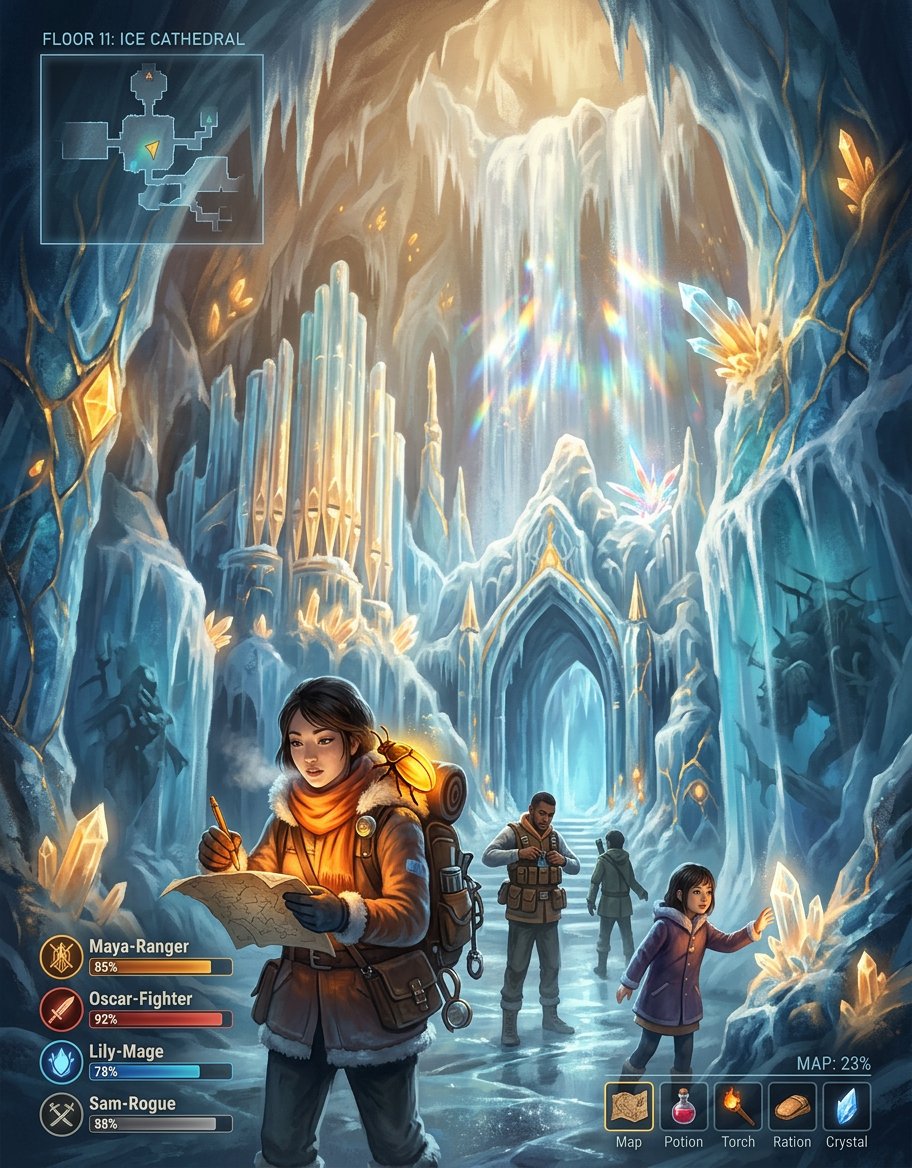
The staircase opened onto a world made entirely of ice.
The cavern stretched farther than her flashlight could reach. Frozen waterfalls hung suspended in mid-cascade from a ceiling lost in blue-white darkness – massive curtains of ice caught in the act of falling, their surfaces glittering with crystalline detail so fine that Maya could see individual droplets preserved in the moment of their descent. Crystal formations jutted from the floor and walls like organ pipes, each one humming a faint note that blended with its neighbors into a chord that lived just below the edge of hearing. The ice was so clear in places that she could see shapes frozen inside the walls – dark forms, organic, ancient, suspended like insects in amber.
The air tasted of winter. Sharp. Clean. So dry it crackled in her nostrils.
“Floor Eleven,” Maya breathed, and the words came out in a cloud that crystallized and fell as tiny snowflakes before it had traveled a foot from her lips.
Behind her, Oscar emerged from the staircase and stopped dead. His vest pockets – all fourteen of them – bulged with the thermal supplies Lily had spent two weeks preparing. He’d packed for cold weather based on Bug’s resonance map, but packing for cold weather and standing inside an ice cathedral were different things entirely.
“That’s –” Oscar started.
“I know.”
“It’s –”
“I know.”
Lily came through next, messenger bag swinging, and walked straight into Oscar’s back because she was already pulling a crystal thermometer from her pocket. “Temperature reading. Negative twelve Celsius. That’s ten degrees Fahrenheit for anyone keeping track, which is me, because I’m the one whose fingers have to work well enough to –” She looked up. Her glasses fogged instantly, and she pushed them onto her forehead, blinking into the vast blue-white space with naked eyes. “Oh. Oh, that’s not fair. That’s the most beautiful thing I’ve ever seen and I can’t even see it properly.”
Maya was already sketching. Her ink threatened to freeze – the tip of her pen caught and skipped on the cold-stiffened page, leaving scratchy lines instead of her usual smooth curves. She switched to pencil. Graphite didn’t care about temperature. The ice cathedral demanded documentation, and Maya’s cartographer hands obeyed even when her fingers ached with cold.
The scale was impossible. The cavern’s ceiling was at least sixty meters overhead – she estimated it by counting the frozen waterfall curtains and measuring their distance apart. The floor was polished ice over stone, smooth enough to reflect their flashlight beams in long ribbons of light that bounced between crystal formations and made the whole space shimmer.
Bug’s shell plates opened slowly. The beetle’s body radiated heat – a new behavior, something that had started subtly on Floor Ten and was now unmistakable. Warmth poured from Bug’s iridescent carapace in gentle waves, and when Maya cupped her hands around the beetle, it was like holding a living hand warmer. Bug’s glow shifted from amber to a deep gold that caught the ice formations and scattered warm light through the frozen cathedral in fractured prisms.
“Bug, you’re a furnace,” Maya said.
The beetle clicked twice – pleased, maybe, or just cold and compensating. Its mandibles worked the air experimentally, tasting the frozen atmosphere.
“Lily, the thermal paste. Distribute it before our gear locks up.”
Oscar was already unzipping his vest’s lower pockets, pulling out labeled tubes of Lily’s thermal paste – a compound she’d crafted from Floor Nine cave moss and refined fire crystals, designed to keep equipment functional in extreme temperatures. He squeezed a line of paste along Maya’s pen barrel, along the spine of her composition notebook, along the zipper of Lily’s messenger bag where the metal was already beginning to stick.
The paste smoked faintly in the cold, releasing a subtle warmth that kept the mechanisms moving.
“Sound is wrong here,” Maya said, pausing her sketch. She tilted her head, listening. The cavern’s acoustics were unlike anything she’d mapped before. Her own voice arrived back at her ears from three different directions, each echo fractionally delayed, as if the sound was bouncing off surfaces at vastly different distances. And underneath her voice, threaded through the crystal formations’ ambient chord, she heard something else.
Whispers.
Not the statue’s whispers – she knew that sound, and it made her skin crawl in a way this didn’t. These were softer. Older. Whispers that sounded like they’d been traveling for a long time, echoing down from floors above, growing fainter with each bounce until they arrived here as ghosts of sound. She could almost make out words, but they dissolved when she focused on them, like trying to read letters written in smoke.
“Maya.” Oscar’s voice was careful. “What do you hear?”
“Everything. The acoustics carry sounds from the upper floors. I can hear echoes from three stories up.” She marked the phenomenon on her map with a new notation – concentric circles indicating unusual sound propagation. “The ice transmits vibration differently than stone. Every noise we make will travel.”
“So monsters can hear us from farther away.”
“And we can hear them. It cuts both ways.”
She pressed her pencil against the page and drew the cathedral’s broad strokes. The central chamber with its frozen waterfalls. The crystal pipe formations clustered along the eastern wall. Corridors of blue-white ice branching north and south, their surfaces so transparent she could see the shapes inside the walls – dark organic forms that might have been plants or creatures or something else entirely, trapped when the ice formed centuries or millennia ago.
A sound split the silence.
Not an echo. Not a whisper from above. A cracking, grinding noise that traveled through the ice floor and up through Maya’s boots – the sound of something massive moving through frozen terrain. Crystal segments clicking against each other like a centipede’s legs made of glass.
“What was that?” Lily whispered.
Bug’s gold glow strobed to red for a single pulse, then back. Danger. But not close. Not yet.
Maya tracked the sound. It came from the northern corridor, moving east to west, the clicking of crystal segments growing louder and then softer as the thing – whatever it was – passed through a parallel passage. She sketched a dotted line on her map showing the creature’s trajectory.
“Something with crystal-segment body structure,” she murmured. “Moving through the ice corridors. Big. Heavy enough to make the floor vibrate.”
“How big?” Oscar asked.
“Big enough that I can track its movement through seismic vibration alone.”
Oscar checked his supply vest. His lips moved silently – counting rations, healing crystals, thermal paste reserves. His stress inventory. “We have provisions for twelve hours in cold-weather conditions. After that, the thermal paste runs low and our gear starts freezing.”
“Then we map fast.” Maya blew on her pencil hand, flexed her fingers, and started down the northern corridor. The ice was slick under her boots, but Bug had adapted for that too – the beetle hopped from Maya’s shoulder to the wall and pressed its mandibles against the frozen surface. Where they touched, the ice melted in small dimples, creating handholds and footholds in the otherwise frictionless surface.
“Bug! You can melt ice?”
The beetle clicked once. Obviously.
Maya laughed, and the sound bounced through the frozen cathedral in crystalline echoes, bright and musical, as if the ice was laughing with her.
They moved deeper. The corridors branched and reconnected in patterns that Maya sketched frantically, her pencil working faster than her frozen fingers wanted to allow. The ice walls were translucent enough that she could see into adjacent passages, but the refraction distorted distances and angles, making the map unreliable in ways her usual cartography didn’t account for. She invented a new notation on the spot: dashed lines for visually confirmed passages versus solid lines for physically traversed ones.
The crystal formations grew larger as they pushed north. Some were taller than Oscar, their surfaces carved by centuries of sublimation into shapes that looked almost deliberate – spirals, arches, formations that resembled frozen trees or the ribcage of some enormous buried creature. The ambient chord they produced grew deeper and more complex, harmonics layering over harmonics until the air itself seemed to vibrate with music.
Then Maya saw something that stopped her cold.
Deep in the ice wall, past the frozen organic shapes and the ancient crystal formations, past the translucent layers of blue-white ice that had been building for longer than she could calculate – a window.
Not a natural formation. Not a crack or a bubble or an optical illusion created by the ice’s refraction. A window, carved into the cavern wall with deliberate precision, its frame made of the same dark stone she’d seen in the Floor One carvings. Stone that predated the ice. Stone that predated everything.
The window looked out onto nothing.
Blackness. Absolute. Not the darkness of an unlit room or a deep tunnel – the darkness of absence. The void beyond the dungeon’s walls. Maya pressed her face against the glass – it was glass, actual glass, cold enough to burn her cheek – and stared into the nothing.
Something moved.
She pulled back. Her heart hammered against her ribs. Bug’s glow plunged to deep indigo – fear, raw and unmistakable – and the beetle’s mandibles chattered in a rhythm Maya had never heard before. Fast. Frantic. A warning that went beyond the usual red-pulse danger signal into something primal.
“Maya?” Oscar was at her shoulder, his voice dropping to the quiet register that meant he’d seen her face and didn’t like what it was telling him. “What is it?”
Maya looked at the window. At the darkness beyond it. At the shapes she’d seen moving in the void – dark, flowing, formless, pressing against the glass like something testing a barrier.
“I found a window,” she said. Her voice sounded strange in her own ears. “We should keep moving. I want to see more of the floor before we map the details.”
It wasn’t exactly a lie. But it wasn’t the truth, either.
She sketched the window on her map and gave it a new symbol – a circle with a crack through it. The dungeon had walls. And something was on the other side.
They pressed deeper into the ice cathedral. Bug’s glow stayed indigo for a long time before slowly warming back to gold. The beetle didn’t look at the window again. Neither did Maya.
But when she glanced back one last time before the corridor curved out of sight, she saw something on the glass that made her pencil go still against the page.
A handprint. On the outside of the window.
It had too many fingers.