
Chapter 1: “The Voice in the Core”
The Core was talking, and Jordan could not make it stop.
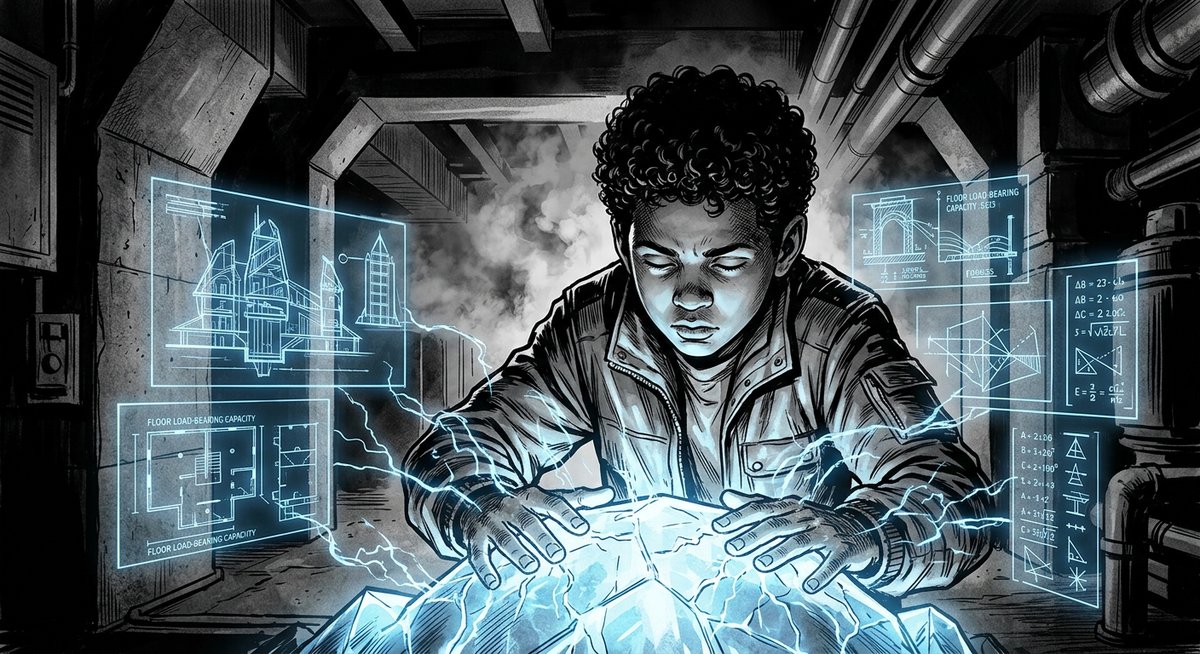
They knelt in the chamber at midnight, palms flat against the crystalline surface. The crystal was warm – warmer than it had been since the deep expedition, warmer than it should have been at twenty-two percent integrity. Something behind the lattice was paying attention. Something old and vast and patient, pressing against the inside of the Core like a face against a window.
Jordan had been coming here every night for a week, alone, before the others arrived for wave defense. One hour of silence in the blue-lit chamber beneath the intersection, hands on the crystal, listening. The Architect’s presence hummed through the network constantly now – a background vibration that tingled in Jordan’s fingertips whenever they touched a blueprint interface. But tonight, for the first time, the hum had texture.
Not words. The Architect did not speak in words.
Jordan felt stress loads shift through the crystal – urgency, translated into the language of collapsing beams. Foundation depths resonated through their palms – importance, expressed as how deep a structure’s roots needed to reach. A cantilever angle adjusted itself, transmitting uncertainty through the precise degree of its overhang. The Architect thought in buildings. It communicated in architecture. And Jordan, the Builder, was the only one who could hold the conversation.
It’s like learning to read by touching the pages.
Jordan pressed harder against the surface. The crystal pulsed. A new concept arrived – complex, layered, built from interlocking structural metaphors that Jordan had to disassemble piece by piece. The Architect was describing its confusion. It had designed the Core defense system for adult operators. Trained professionals with decades of experience, institutional support, engineering backgrounds. Instead, it had found four kids. Untrained. Unsupported. Improvising with a fraction of the system’s capacity.
The structural metaphor the Architect used translated roughly as: building a skyscraper with a hammer and no blueprints.
Jordan’s hands tightened on the crystal. An insult. It had to be.
But the emotional resonance beneath the metaphor was not contempt. It was awe. The Architect had watched them fight for months through the deep network. It had seen Jordan build walls from pure instinct during the broadcast night, slapping salvage into gaps without blueprints or plans. It had seen Amara hold a perimeter with nothing but stubbornness and basketball metaphors. It had watched Hiro build a broadcast amplifier from toaster parts and prayer. It had observed Des stand on a broken wall and speak to the darkness until the darkness listened.
The skyscraper metaphor was not an insult. It was wonder. These children had accomplished things the Architect’s design never anticipated.
Jordan exhaled. Their breath fogged in the chamber’s cool air, the mist catching the blue light and scattering it like dust motes. They closed their eyes and let the next wave of structural concepts wash through them. The Architect was trying to explain something about itself now – its nature, its origin. The concepts came in layers: a vast structure collapsing inward. A consciousness surviving the collapse by embedding itself in the wreckage. Centuries of isolation, maintaining the Cores from the deep network, watching through crystalline eyes as the system it built slowly wore down.
Loneliness. The Architect was lonely.
That was not a structural concept. That was something Jordan felt beneath the architecture, the way you could feel the foundation of a building settle if you pressed your ear to the floor. The Architect had been alone in the deep network for three hundred years. No one to talk to. No one who could understand its language. Until a twelve-year-old Builder with paint-stained fingers put their hands on the crystal and started listening.
Jordan stayed at the Core for another twenty minutes, receiving concepts, translating, filing the structural language away in the part of their brain that thought in load paths and compression angles. The conversation was exhausting – every concept required effort to decode, like reading a book in a language you were still learning. By the time the others arrived, Jordan’s head ached and their fingers were numb from the crystal’s vibration.
But they had understood. And understanding was the first step toward building something.
The wave was manageable. Ninety Crawlers, a dozen Flyers, two Phase-Shifters. Light, by recent standards. The team’s broadcast modification had changed the calculus – roughly thirty percent of the Crawlers paused when Des narrated from the observation post, their shadow-substance rippling with the carrier wave’s frequency. Thirty percent fewer enemies made every night survivable instead of catastrophic.
Jordan built emergency patches along the north perimeter, where three Crawlers had gnawed through a barricade segment during the opening minutes. Their hands moved by feel – no blueprint, no plan, just the instinct that told them a forty-five-degree angle would deflect more shadow-substance than a flat face. The wall that resulted looked like it had been assembled by a very determined tornado. It held.
Amara sprinted between sectors, hardening walls as Crawlers tested them. She was loud tonight, louder than usual, her trash-talk echoing off buildings that did not exist in the daytime. “You call that an assault? I’ve seen scarier things in my little sister’s bedroom! She’s SEVEN!”
Hiro managed the turrets and broadcast amplifier from the Core intersection, splitting his attention between targeting algorithms and the carrier wave’s modulation. The amplifier hummed its steady frequency, the sound that made some Null creatures pause and listen instead of attack.
Des narrated from the observation rooftop, her documentary voice threading through the chaos like a calm radio signal through static. “The Crawlers approach the north barricade with admirable persistence and zero tactical awareness. The Recon notes their commitment to failure.”
Core integrity held at twenty-two percent. No gains. No losses. Stalemate.
At dawn, the transformation reversed. Streets smoothed. Walls dissolved. The neighborhood returned to its daytime mask of normality, and four exhausted kids walked home through streets that showed no trace of the war fought on them hours before.
Jordan caught the team at lunch the next day. The school cafeteria was loud – trays clattering, someone’s phone playing music from two tables over, the permanent smell of overcooked pasta that hung in the air like weather. Jordan spread their sketchbook on the table between bites of a sandwich they were not really tasting.
“The Architect talked to me last night,” Jordan said.
Three pairs of eyes locked on.
“Talked how?” Hiro asked. He set his milk carton down with the precision of someone placing a delicate instrument. “The Architect’s communication modality is structural, not linguistic. It cannot produce speech as we understand –”
“It thinks in buildings,” Jordan said. “I translated.”
“What did it say?” Des leaned forward. Her cornrows caught the fluorescent light as she tilted her head. “Strategic intelligence? Force projections? Null composition data?”
“Weapons,” Amara said immediately. “Tell me it gave us weapons.”
Jordan shook their head. “It doesn’t think in those categories. It thinks in structures.” They flipped the sketchbook open to a page covered in architectural annotations – load diagrams, stress vectors, foundation sketches, all rendered in Jordan’s quick, rough style. “It’s confused. The system was designed for adults. Trained adults. Dozens of them. Instead it got us.”
“Four twelve-year-olds with a combined engineering degree of zero,” Hiro said.
“It’s not an insult. It’s – I think the Architect is impressed. And scared.” Jordan tapped the sketchbook. “It keeps sending me concepts about the boundary structure. The thing holding the Null dimension back from ours. It’s worried about it.”
“It should be worried,” Amara said. “Core’s at twenty-two percent. The boundary’s running on fumes.”
“It’s worse than that.” Jordan looked at each of them in turn. The cafeteria hummed around them, oblivious. A kid at the next table argued about a video game. Someone spilled juice. The world was normal, and the secret sitting between Jordan’s team was anything but. “The Architect isn’t just worried about our Core. It’s worried about all of them. The whole system. It keeps sending this one concept over and over – I can’t translate it perfectly, but the closest thing in English is ‘the patch is failing.’”
Silence settled over the table. Around them, the cafeteria hummed with the noise of normal kids living normal lives. Someone laughed. A tray dropped. The pasta smell persisted.
“Patch,” Hiro repeated. He was doing the thing where his eyes went distant and his mind started building models. “The Cores were designed as a temporary containment system. The Architect built them centuries ago as a stopgap. If the Architect is calling them a patch –”
“Then the patch is what’s failing,” Des finished. “Not just our Core. The whole system.”
Jordan closed the sketchbook. The structural concept the Architect had sent last – the final transmission before Jordan had pulled their hands away – sat in their mind like a blueprint they could not unsee. They had spent the whole morning sitting through English and History and Art, trying to focus on normal school things while the Architect’s final message burned behind their eyes.
“There’s something else,” Jordan said. “A message it keeps repeating. I didn’t understand it at first, but I think I’ve got the translation now.”
They opened to a fresh page and wrote, in block letters that trembled slightly:
THE CORES WERE DESIGNED TO LAST FIFTY YEARS. THEY HAVE BEEN RUNNING FOR THREE HUNDRED. THE SYSTEM IS NOT FAILING. IT HAS ALREADY FAILED. WHAT REMAINS IS INERTIA.
Amara read it twice. Then she pushed her tray away, appetite gone.
“So what do we do?”
Jordan looked at the words on the page. The block letters stared back, stark against the white paper, a message from something that had been fighting alone for longer than any of them could comprehend. “We keep talking to the Architect. We find out what it knows. And we figure out if there’s a fix that isn’t temporary.”
Hiro picked up his milk carton again. “I want technical specifications. If the Architect designed the Core system, it has schematics. Data. Engineering documentation. The system is mechanical at its foundation – mechanical things can be understood and repaired.”
“I want tactical intel,” Des said. “Force projections. The Source’s capabilities. What we’re actually fighting and what it’s planning.”
Amara cracked her knuckles under the table. The sound was small but decisive. “And I want to know why kids are running a system built for adults. Because that part doesn’t make sense, and things that don’t make sense get people hurt.”
Jordan tucked the sketchbook into their back pocket. The Architect’s presence hummed in their memory – that vast, patient, ancient attention pressing against the Core like a hand against glass. Three hundred years of solitude, maintaining a failing system, waiting for someone who could understand.
Tonight, Jordan would press back. Tonight, they would stop listening and start asking.
The cafeteria bell rang. Lunch was over. The war was not.