Chapter 1: After Dark
The sun dropped behind the roofline of Flores Grocery, and the ground shuddered beneath Jordan Castillo’s sneakers.
Jordan stumbled sideways, sketchbook flying from under their arm. It hit the alley pavement and skidded into a puddle of something brown. Jordan lunged for it — the sketchbook always came first — and the world split open.
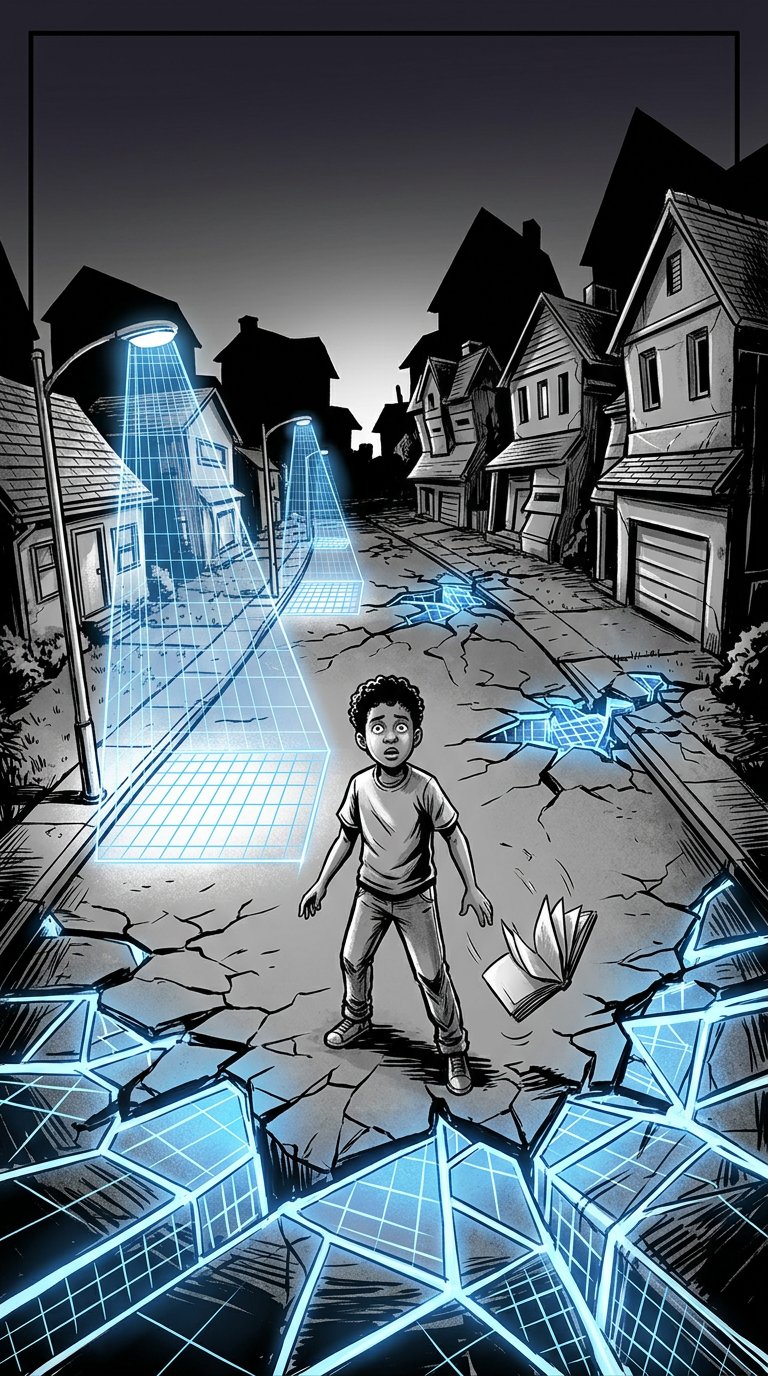
The asphalt cracked. Not the way potholes formed over years of rain and traffic. This was geometric. Precise. Trenches carved themselves into the street in clean, angled lines, like someone was unfolding origami made of concrete. Jordan pressed against the brick wall of the grocery store and watched a garage door across the alley buckle outward, its thin aluminum panels reshaping into overlapping plates of something thicker, harder, like armor bolted onto a tank.
The streetlight above Jordan’s head flickered. Died. Then reignited in a color that did not belong to any bulb Jordan had ever seen — a pale, cold blue that projected upward in a column of light so sharp it looked solid enough to touch.
Jordan’s hands were shaking. Their fingers left wet prints on the rescued sketchbook.
Draw it, some part of their brain whispered. You need to draw this.
Their pencil was already moving. Quick lines. The trench pattern. The armored garage. The column of blue. Jordan’s hand captured what their mind could not process — the entire block reshaping itself in sixty seconds flat. Fences stretched into barricade walls. Fire hydrants sank into the ground and reappeared as squat, angular posts that hummed with faint vibration. A chain-link fence behind the Nguyens’ house pulled taut and wove itself into a lattice of interlocking metal diamonds, each one thick as Jordan’s thumb.
The shaking stopped. The neighborhood held its new shape, alien and armored, glowing faintly blue in the last light of the evening.
Jordan’s second instinct was to run.
They shoved the sketchbook into their back pocket, smearing wet brown across the denim. The pencil went behind their ear. For a wild second, Jordan considered running home — three blocks north, up the fire escape, through the window they always left cracked. But the street between here and there wasn’t the street anymore. The sidewalk had split into terraced steps, each one angled outward like defensive fortifications. The mailbox on the corner had stretched upward into a narrow tower, its metal skin reinforced with angular ridges that caught the blue light and threw sharp shadows across the pavement.
Home was three blocks away. It might as well have been three miles.
Jordan ran anyway, choosing speed over direction, and got three steps before colliding with someone coming the other way — someone tall, fast, and already breathing hard.
“Get down!” Amara Jackson grabbed Jordan by the shoulder of their army-surplus jacket and hauled them behind a transformed dumpster. The dumpster had grown angular buttresses on both sides, reinforced steel braces that turned a trash container into something that looked like it belonged on a battlefield.
“Amara, the street — did you see —”
“I saw.” Amara’s eyes were scanning every direction at once. She’d been shooting hoops at the park two blocks over — still wearing her basketball shorts, her practice ball abandoned somewhere behind her. Her twist-outs were coming loose on one side from sprinting. “The whole park folded up like a card table. The benches turned into walls. The basketball hoop—” She stopped. Her jaw tightened. “It doesn’t matter. Something’s wrong and we need to move.”
“Where?”
Amara didn’t answer. She was already looking past Jordan, assessing the reshaped alley the way she assessed a basketball court — threats, openings, angles of approach.
A voice drifted out of a garage-turned-armory to their left, calm and measured in a way that seemed profoundly inappropriate given the circumstances.
“This is structurally impossible.”
Jordan peered around the dumpster’s new armor plating. Hiro Tanaka stood inside Mr. Petersen’s garage, which no longer contained Mr. Petersen’s Toyota Camry. The car was gone. In its place stood racks of angular components — panels, braces, connectors — arranged in precise rows like merchandise in a hardware store that didn’t exist five minutes ago. Hiro had his thin-framed glasses pushed up on his nose and was running his hand along one of the panels. His oversized hoodie swallowed his arms up to the fingertips.
“The molecular restructuring required to convert standard residential aluminum into this alloy would need—” He paused. Noticed Jordan and Amara staring at him. “Something changed the garage into a supply room. I don’t know how.”
“We noticed,” Amara said. “The whole block did it.”
“Fascinating,” Hiro said, in the same tone someone might use to describe a moderately interesting sandwich.
A fire escape rattled above them. All three looked up.
Destiny Okafor crouched on the second-floor landing of the apartment building next to the grocery store, her cornrows catching the blue light, her dark eyes scanning the transformed rooftops with an intensity that made Jordan think of a hawk. Des had one hand on the railing and one foot already positioned for a quick descent. She was always like that — ready to move, ready to run, always halfway to somewhere else.
“The Recon surveys the chaos from her elevated position,” Des said, her voice pitched low and steady like a nature-documentary narrator. “She observes significant environmental restructuring across a perimeter of at least three blocks. She is, for the record, deeply concerned.”
“Des, get down here,” Amara said.
“The Recon declines. Elevated position provides superior tactical awareness.” Des leaned over the railing. “Also, the street is doing something gross.”
Jordan looked down. She was right. The geometric trenches that had carved themselves into the asphalt were glowing faintly at their edges — the same cold blue as the streetlights — and something dark was shifting inside them. Not flowing like water. Moving. Skittering. Small shapes, dozens of them, sliding through the narrow channels toward the intersection at the center of the block.
“What is that?” Jordan whispered.
Hiro stepped out of the garage and knelt beside the nearest trench. He tilted his head, studying the movement below. “Some kind of — I want to say biological, but the way they move suggests—”
“Hiro.” Amara’s voice had changed. It was the voice she used in the third quarter of a close game, when the other team was making a run. Controlled. Hard. “Can we figure out what they are after we figure out if they’re dangerous?”
“Those two questions might have the same answer,” Hiro said. He pulled a pair of wire snips from his hoodie pocket — the tools he always carried, the way other kids carried phones — and used them to pry a loose chip of transformed pavement from the trench’s edge. He held the chip up to the blue light and turned it like a jeweler examining a stone. “The material restructuring alone would require energy equivalent to—”
“Hiro,” Amara said again.
He pocketed the chip. “Later.”
The blue light from the streetlamps intensified. Jordan felt it on their skin — not warmth, but pressure, like standing too close to a speaker playing a note too low to hear. Their sketchbook pages riffled in a wind that wasn’t there.
Des dropped from the fire escape, landing on the transformed sidewalk in a crouch. Her running shoes — lightweight, built for speed, worn even to school events — barely made a sound. “Movement from three directions. Those trench things are like highways. Whatever’s in them, it’s all heading the same way.” She pointed toward the intersection. “Center of the block.”
Amara made a decision in the space of a heartbeat. “We stick together. Stay off the trenches. Move toward the intersection and figure out what’s drawing them.”
“That seems like the opposite of a good plan,” Hiro said.
“You got a better one?”
Hiro opened his mouth. Closed it. Pushed his glasses up. “No.”
They moved as a group — Amara at the front because she couldn’t be anywhere else, Jordan behind her with the sketchbook clutched to their chest, Hiro scanning the altered architecture with the focused attention of someone reading a textbook, and Des drifting to the edges, checking angles, climbing anything that gave her a better view.
The neighborhood was unrecognizable. Mrs. Chen’s flower garden had retracted into the ground, replaced by a flat platform of interlocking hexagonal tiles. The Rodriguezes’ wooden fence had thickened into a low wall with angular notches cut into the top — crenellations, Jordan realized. Like a castle. Their hand itched to sketch them.
The air tasted wrong. Metallic. Like licking a battery, sharp and electric on the back of Jordan’s tongue. And beneath everything, a vibration — not in the ground this time, but in the air itself, a pressure that made Jordan’s ears feel full, like descending in an airplane.
They reached the corner of Maple and Fourth. The intersection spread out before them, and what Jordan saw made them stop so suddenly that Hiro walked into their back.
The crossroads had opened. The pavement had pulled apart in a perfect circle, thirty feet across, revealing layers of earth and concrete and pipe work descending into a bowl-shaped depression. And at the center of that bowl, maybe thirty feet down through cracked pavement layers, something pulsed with light.
A sphere. Crystalline. The size of a basketball, nested in a cradle of reshaped rebar and stone. Cold blue light radiated from its surface in steady, rhythmic pulses, and each pulse sent that pressure wave rolling outward through the ground, through the walls, through Jordan’s chest.
“What—” Jordan started.
Des held up a hand. She was staring past the intersection, past the glowing sphere, into the darkness beyond the reach of the blue light. Her documentary voice was gone. When she spoke, it was quiet and honest and stripped of performance.
“Something’s coming.”
Jordan listened. Behind them, below them, all around them — in the trenches, in the cracks, in every gap between every reshaped structure on the block — a sound was rising. Scratching. Skittering. Hundreds of small things moving across stone and metal, getting closer, getting louder.
Moving toward them in the dark.