Chapter 1: Standardization
The dead drop at the park fountain hasn’t been emptied in thirty-one hours.
I check it during my afternoon route – the same circuit I’ve walked every day for three weeks, timed to the gap between the 3:15 bus and the 3:42 crosswalk light. The fountain’s drainage grate has a loose panel on the west side. Behind it, a waterproof envelope. Today, the envelope is still there. Zara’s Lincoln report from yesterday, uncollected.
That’s wrong. Diego runs the fountain circuit on alternating days. He’s never missed a pickup.
I scan the park. Two joggers, both regulars. A woman with a stroller, sight cone locked on her phone. An older man on the bench by the memorial, reading a newspaper with the intensity of someone who’s actually reading it. No threats. No anomalies.
But the dead drop is full. And that means the routine is broken.
SHADOW NETWORK STATUS: 4 NODES ACTIVE. Dead drops: 12 locations, 4 schools. Last full cycle: 31 hours ago. Anomaly detected: PARK FOUNTAIN – uncollected.
Three weeks since District Play. Three weeks since we named the Shadow Network and started threading analog communication through the cracks in the organization’s digital surveillance. The system works. Dead drops running, intelligence flowing, four schools coordinating through paper and pencil while the organization monitors every digital channel and sees nothing.
My rank: 22. Stable. The team is operational. Life, for the first time since I found the glasses in the lost and found, feels almost manageable.
I collect the uncollected drop myself. Zara’s report is routine – perimeter observations, no organizational activity near Lincoln, Pack patrols maintaining coverage. Nothing urgent. Nothing that explains why Diego missed his pickup.
I find out why at 3:47.
The glasses buzz. Not a gentle notification. A system-wide pulse that makes my vision strobe.
I stop walking. The HUD floods with text I’ve never seen before – a broadcast notification, pushed simultaneously to every player in the district. Every HUD in every school. The digital equivalent of someone grabbing the emergency intercom and screaming.
[SYSTEM – ALL PARTICIPANTS] ATTENTION. THE BOARD HAS AUTHORIZED A DISTRICT REVIEW. A COMPLIANCE OFFICER WILL EVALUATE ALL FOUR GAME SITES OVER THE NEXT 30 DAYS. GAME OPERATIONS CONTINUE DURING REVIEW. COOPERATE FULLY.
I read it twice. Three times.
A compliance officer. The Board. District review.
The words are bureaucratic, bloodless, the language of institutional control dressed in professional courtesy. But underneath the corporate phrasing, the message is a hammer: someone is coming. Someone with authority above the Wardens. Someone sent by the organization itself.
My phone buzzes in my pocket. Not game infrastructure – actual phone, actual text. Diego: Did you see that???
Everyone saw it. Every player in four schools just received the same notification. The game’s secrecy – its defining characteristic, the invisible architecture that runs beneath the surface of normal school life – just sent a mass broadcast. Whatever is coming is important enough to break protocol.
Ms. Osei goes quiet.
I find her in the library at 4:15, shelving returns with the mechanical precision of someone performing a task she’s done ten thousand times. The warm smile is in place. The reading glasses dangle from their beaded chain. She looks exactly like a school librarian finishing her afternoon routine.
But her sight cone is wrong.
Through the HUD, I watch the cone that represents her field of visual attention. Normally, Ms. Osei’s sight cone is moderate and deliberate – the steady sweep of a Warden monitoring her arena. Today, it’s at near-zero. A narrow sliver pointed at nothing. She’s not looking at the books she’s shelving. She’s not scanning the library. She’s not watching anything.
She’s making herself invisible.
The Warden is hiding.
“Ms. Osei.”
She doesn’t startle. She never startles. She slides a biography of Harriet Tubman into its alphabetical slot and turns with the measured warmth of a woman who has been playing her cover role for twenty-five years. “Nadia. You need a book?”
“I need information. The district review notification. Who is the compliance officer?”
“I’m sure we’ll all find out tomorrow. The district office typically introduces consultants at the morning faculty meeting.” Her smile doesn’t waver. Her sight cone doesn’t expand. She’s giving me the librarian, not the Warden. Full cover. Zero game.
“You already know who it is.”
“I know many things. Not all of them are useful to share.”
“This one is.”
She regards me. For a moment, the Warden surfaces – the sharp, assessing intelligence behind the cardigan and reading glasses, the woman who won the game twenty-five years ago and has been running it ever since. Then she shelves another book.
“Go home, Nadia. Get rest. Tomorrow will be a long day.”
She turns back to the returns cart. Her sight cone stays at near-zero. A woman who controls the entire game infrastructure at Westbrook Middle School, who monitors hundreds of students through hidden cameras and sensor networks and decades of institutional knowledge, choosing to look at nothing.
Whatever is coming, the Warden doesn’t want to see it.
The Compliance Officer arrives the next morning.
He introduces himself at the 7:30 faculty meeting as Mr. Calloway, a “district educational consultant” evaluating technology integration across the four middle schools. I’m not in the meeting – I’m in the hallway outside the main office, pressed against the wall beside the trophy case, listening through the gap between the double doors.
His voice is unremarkable. Mild. The vocal equivalent of beige wallpaper. He thanks Principal Torres for the welcome. He outlines his thirty-day evaluation timeline. He mentions classroom observations, teacher interviews, technology infrastructure assessments. Everything a real educational consultant would say.
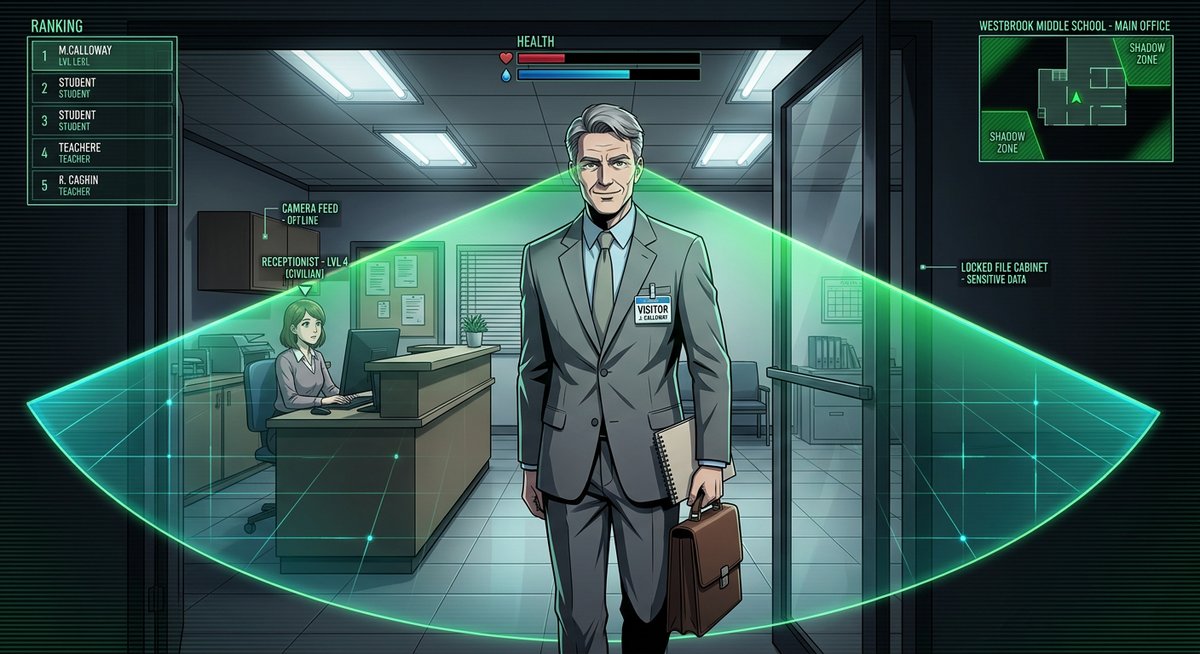
I watch him through the office window as the meeting ends and faculty files out. He’s in his fifties, gray-haired, medium build. Khaki pants, blue button-down, visitor’s badge clipped to his breast pocket. He looks like someone’s boring uncle. The kind of adult you’d forget five seconds after meeting him.
My HUD disagrees.
His sight cone is the widest I’ve ever seen on a non-player. Nearly 180 degrees – a sweeping field of awareness that covers every angle of the office like a searchlight. Most people’s sight cones are narrow, focused on whatever they’re directly looking at. Mr. Calloway’s cone radiates outward in all directions. He’s not looking at any one thing. He’s seeing everything.
He scans the hallway through the window. I flatten against the trophy case. His cone sweeps past my position – and I feel it. Not physically. But the HUD flickers, the way it does when a high-level player’s awareness passes close. An involuntary chill runs down my spine.
He’s not a player. His profile shows no class designation, no ranking, no game data. He exists outside the HUD’s taxonomy entirely.
He’s something worse than a player. He’s the person who designs the game the players play.
I spend the rest of the morning watching him.
Calloway moves through Westbrook with the patient thoroughness of someone taking inventory. First period: Principal Torres’s office, reviewing enrollment data. Second period: the technology lab, examining network infrastructure. Third period: a classroom observation in Mr. Henderson’s social studies class.
From the outside, every stop looks legitimate. An educational consultant doing exactly what he said he’d do.
But I watch the way he watches. And the data is wrong.
He lingers in hallways where the game’s hidden cameras are concealed behind ventilation grates. He pauses at doorways where sensor nodes are tucked inside light fixtures. He stands in the main corridor for exactly ninety seconds – the camera cycling gap I mapped in Book 2 – before moving on.
He knows where every piece of game infrastructure is located.
He built it.
At lunch, I find the team in blind spot seven.
“His sight cone is impossible,” I tell them. “Nearly 180 degrees. I’ve never seen anything like it.”
Eunji’s fingers are still on her notebook. She’s been writing since I started talking. “Natural awareness, not HUD-enhanced. Trained over decades. He reads rooms the way I read people – automatically, constantly, without conscious effort.” She looks up. “He also knows we’re watching. He looked directly at my observation position twice during second period. Both times, he smiled.”
“He smiled?” Diego stops unwrapping his sandwich. “That’s terrifying.”
“It’s data,” Eunji says. “He wanted me to know he knew. That’s a message. He’s saying: I see your surveillance. I’m not threatened by it.”
Marcus leans against the wall, arms crossed. His bulk fills the doorway, blocking the corridor’s line of sight. “So what is he? Not a player. Not a Warden. What?”
“He’s a handler,” Kai says from the corner. Everyone turns. Kai has been attending morning briefings since the end of Book 4, but he rarely speaks first. “The organization sends handlers when a game site requires direct evaluation. Ms. Osei mentioned them once – people from above the Wardens who inspect, assess, and recommend action.”
“What kind of action?”
“Anything from operational adjustments to complete shutdown.”
The room goes silent. Complete shutdown. Two words that mean the end of the game at Westbrook. The end of the HUD. The end of the team. The end of everything we’ve built.
“He can’t shut down the game,” Diego says. “Can he?”
Nobody answers. Because nobody knows.
I watch Calloway through the library window at 2:30.
He’s on the ground floor, walking toward the circulation desk with the casual purpose of a man browsing. His sight cone sweeps ahead of him, cataloging the space. He pauses. Adjusts his visitor’s badge. Enters the library.
Ms. Osei is at the circulation desk. She greets him with professional warmth. The smile of a librarian meeting a visitor. Perfectly appropriate. Perfectly calibrated.
They shake hands.
On my HUD, the social web connection between Calloway and Ms. Osei flares. Not the thin thread of a new acquaintance. Not the moderate line of a professional contact. A deep, tangled web of connection, thick with history, layered with complexity. The kind of connection the HUD only shows between people who have known each other for years.
They know each other. They’ve known each other for a long time.
And Ms. Osei never mentioned him. Not once. Not in any briefing, any conversation, any Warden communication. Twenty-five years of running the game, and she never told me about the man who just walked into her library like he owned it.
Either she forgot. Or she was hiding him.
Ms. Osei doesn’t forget things.
SOCIAL WEB: CALLOWAY <-> OSEI. Connection depth: DEEP. Connection age: CLASSIFIED. Connection type: CLASSIFIED. Note: Historical relationship. Pre-dates current game cycle.
Classified. The system itself won’t tell me what their connection means.
I press my forehead against the window glass and watch the most dangerous person in the school shake hands with the Warden, and I realize that the game I thought I understood just grew a layer I never knew existed.