Chapter 1: The Afternoon Meeting
Jordan’s best blueprint was also their most useless one.
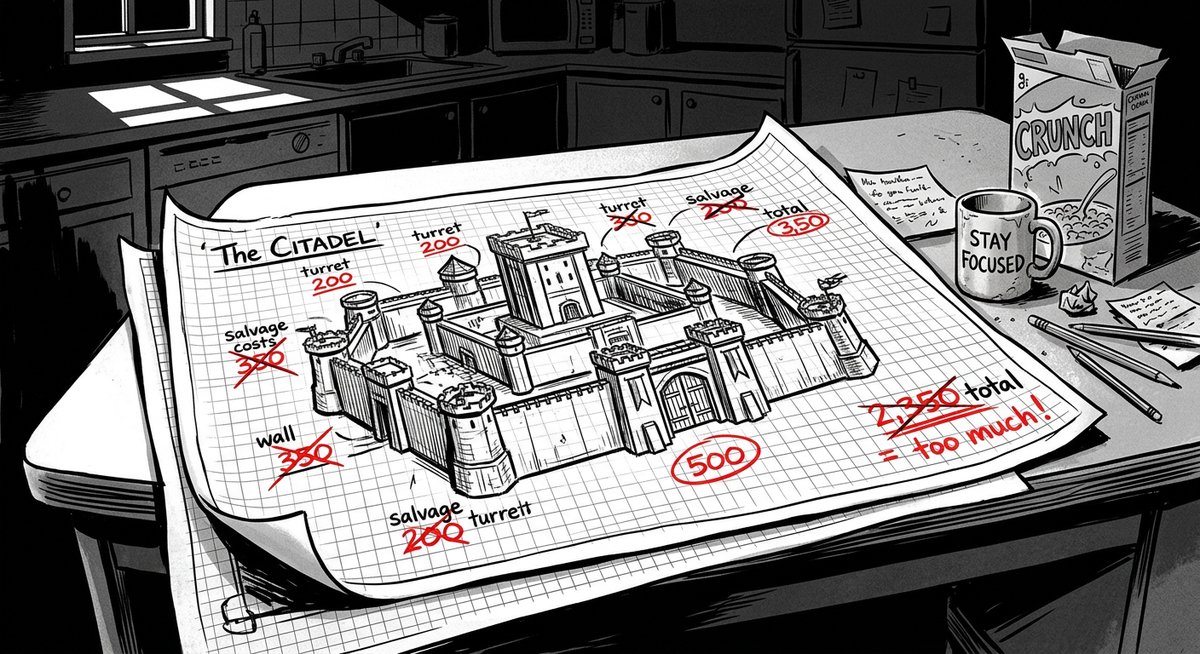
They had drawn it during third-period math, hidden behind a propped-up textbook while Mrs. Reeves explained long division at the whiteboard. The pencil moved on its own, sketching a concentric ring defense with interlocking walls, elevated turret platforms, and an overhead canopy that extended across the entire perimeter. It was beautiful. Clean lines, measured angles, structural logic that flowed from the center outward like ripples in still water. Jordan had titled it at the top in neat block letters: THE CITADEL.
It would cost approximately four times the salvage they had.
Jordan spread the sketchbook across Amara’s kitchen table at 5:02 PM, pushing aside a stack of spelling worksheets that belonged to Amara’s youngest sister. The afternoon sun slanted through the window above the sink, warm and golden, and the kitchen smelled like the rice Amara’s mom had started in the cooker before leaving for her shift. Two hours to sundown. Two hours until the streets cracked open and the world they knew folded itself into something that wanted to eat them.
“Okay,” Jordan said, smoothing the page. “The outer wall ring goes here, here, and here. It connects to the spiral wall from last night, which the Core should rebuild at reduced integrity when the transformation hits. Inside the ring, I’ve designed interior channels — narrow passages that force the Crawlers into single-file lines so the turret can pick them off. And overhead…” Jordan traced the canopy sketch with a fingertip. “Full coverage. The Flyer can’t dive if there’s no gap.”
Amara leaned over the table from the other side, her freshly redone twist-outs falling forward. She had spent two hours on her hair after school, which Jordan suspected was less about vanity and more about controlling something in a world that had stopped making sense. “What about the breach points? Last night they hit us from three directions at once.”
“The channels solve that. They funnel everything into kill zones. Four entrances, four kill zones, turret coverage on all of them.”
“That’s clean.” Amara nodded, and Jordan felt a glow of validation that lasted exactly four seconds.
Hiro sat at the end of the table with Amara’s mom’s phone calculator open, his cracked glasses taped with fresh medical tape from the school nurse. He had been punching numbers since Jordan started talking. He did not look up. His thumb moved across the screen with the methodical rhythm of someone who already knew the answer and was confirming it out of professional obligation.
“Hiro?” Jordan said.
Hiro pushed his glasses up. They slid back down immediately. “The outer wall ring requires approximately one hundred and sixty salvage crystals, assuming standard-density construction. The interior channels add another ninety. The canopy — the full-perimeter version, not the partial one we had last night — is two hundred and ten. Turret upgrades for four-sector coverage, seventy. Emergency repair reserve, minimum fifty.” He set the phone down. “Total cost: five hundred and eighty salvage crystals.”
The kitchen was quiet except for the rice cooker bubbling.
“We have one hundred and forty-three,” Hiro said. “Carried over from last night.”
Jordan stared at the blueprint. The beautiful, useless blueprint with its clean lines and perfect geometry and absolutely impossible price tag. Five hundred and eighty crystals. They had a quarter of that.
“So we fight harder,” Amara said. She pushed off the table and started pacing. Amara always paced during planning — her basketball instincts could not sit still when strategy was being discussed. “We kill more Nulls, we earn more crystals, we build more walls. Simple math.”
“It’s not simple math,” Hiro said. “Every engagement costs salvage in repairs. Last night, our net salvage gain per wave was approximately thirty-eight crystals after repair costs. At that rate, earning five hundred and eighty crystals would take…” He paused, calculating. “Fifteen waves. Minimum. Assuming no structural losses, no escalation in wave difficulty, and no emergencies.”
“We survived twelve waves last night,” Amara said.
“We survived twelve waves and barely covered our expenses. The Siege Null alone cost us eighty crystals in repairs.” Hiro’s voice was level. Not argumentative. Just precise, the way a calculator was precise — it did not care whether you liked the answer. “Fighting harder means taking more damage. Taking more damage means spending more on repairs. Spending more on repairs means less salvage for construction. It’s a trap.”
Amara stopped pacing. Her jaw worked sideways, the way it did when she was processing something she did not want to accept.
Des sat on the kitchen counter beside the refrigerator, her running shoes dangling above the floor. She had been quiet since arriving, which was unusual. Des was never quiet. Des narrated everything — her own movements, the weather, the tactical landscape — in a nature-documentary cadence that was equal parts annoying and reassuring. The silence meant she was thinking hard.
“The economics of defense,” Des said finally, testing the phrase like it was a chapter title. “Every crystal spent on a wall is a crystal we can’t spend on a weapon. Every crystal spent on a weapon is a crystal we can’t spend on a repair. We’re not just building a defense. We’re managing a budget.”
“A very small budget,” Hiro added.
Jordan looked at their blueprint. The Citadel. The beautiful, elegant, impossible Citadel with its concentric rings and its overhead canopy and its four-sector turret coverage. It was the best thing Jordan had ever designed, and most of it would never get built.
The pencil felt heavy in their hand.
“So what do we build?” Jordan asked, and the question came out smaller than they intended. “If we can’t build everything… what matters most?”
The argument started immediately.
Amara wanted walls. Thick walls, strong walls, walls she could stand behind and harden with her Vanguard ability. “Defense first. We shore up the perimeter, make it so nothing gets through, and then we worry about the rest.”
Hiro wanted efficiency. Turret upgrades, automated targeting, systems that killed Nulls without requiring a person to stand in the breach. “We need force multipliers. Amara can’t be everywhere. The turret can.”
Des wanted escape routes. “What happens if the base falls? Last night we almost lost the Core. We need fallback positions, secondary perimeters, a way out if everything goes wrong.”
Jordan wanted all of it and none of it and felt their pencil tracing circles on the page while the team argued around them. Every option was right. Every option was too expensive. Every choice about what to build was also a choice about what to leave exposed.
“Stop,” Jordan said, and the kitchen went quiet. “We’re arguing about how to spend money we don’t have. The real question is how we get more.”
The silence stretched. The rice cooker clicked from cook to warm. The sunlight through the window had shifted, the angle lower, the shadows longer. Ninety minutes to sundown.
A small voice came from the kitchen doorway. “Amara? When’s dinner?”
Amara’s little sister, Keely, stood in the hall in a T-shirt two sizes too big, rubbing her eyes. She was seven. She had no idea that four twelve-year-olds were sitting in her kitchen planning a military operation against creatures made of the shadow of a dead world.
“Mom left rice,” Amara said, and her voice shifted instantly — softer, warmer, the protector speaking. “I’ll make you a plate in a minute. Go watch your show.”
Keely padded away. The sound of a cartoon starting up drifted from the living room.
Amara looked at the table. At the blueprints and the calculator and the three teammates who were also just kids sitting in a kitchen. She rubbed her face with both hands. “This is insane,” she muttered. “This is completely insane.”
“And yet,” Des said from the counter, “here we are.”
Nobody disagreed.
Jordan was staring at the salvage numbers on the calculator when Hiro spoke again. His voice was quieter this time, and he had pulled up a different calculation — one he had been running on his own, separate from the cost analysis. His thumb hovered over the screen.
“There’s another option,” Hiro said. “The Crawlers near the perimeter drop basic salvage. Common crystals, low density. That’s what we collected all last night.” He adjusted his glasses. “But the contested zone — the area beyond the Core’s six-block radius — has higher Null density. And higher density means rarer drops. Denser crystals. More salvage per kill.”
The kitchen went very still.
“If we go deeper,” Hiro said, “further from the Core, where the transformation is more complete and the Nulls are thicker… the yield goes up. Significantly.” He turned the phone around so they could see his projection. The numbers climbed in a steep curve. “A targeted run into the contested zone could yield three to four times our current reserves. Enough for the full build.”
Amara leaned forward. Des slid off the counter. Jordan’s pencil stopped moving.
“You want us to leave the base,” Jordan said.
“I want us to consider it.” Hiro’s voice was calm and level and completely terrifying. “The Nulls are denser out there. But so is the salvage.”
Outside the window, the sun touched the rooftops. One hour to sundown. The shadows in the kitchen stretched across the table, across the blueprints, across four faces that were too young for the math they were doing.
Hiro set the phone down. “It’s another option,” he repeated. “That’s all I’m saying.”
But it was not all he was saying, and everyone at the table knew it.