Chapter 1: “The Cost”
Jordan had never seen the Architect afraid.
They knelt in the Core chamber with their palms against the crystal, the way they had done a hundred times before. But tonight the Core’s warmth was different. Not the steady heat of a working system. This was the warmth of something burning through its last reserves, like a furnace door left open on the final log.
The Architect’s presence filled the chamber. Three months ago, Jordan had struggled to translate the entity’s structural language – load metaphors, stress concepts, architectural feelings pressed through crystal into human hands. Now the conversation flowed like reading. Like breathing. And what the Architect was telling them made breathing hard.
Phase Three. The words did not exist in the Architect’s vocabulary, so it transmitted the concept as a blueprint. Jordan closed their eyes and let the structure build itself in their mind. Every surviving Core in the network – twelve of them, scattered across the city – would discharge simultaneously. Full reserves. Everything they had. The energy would channel through the deep-network conduits into the lock mechanism Jordan and the team had rebuilt inside the rift. The bilateral seal would activate. The gateway between realities would close permanently. Self-sustaining. No maintenance required. No Core support needed.
Because there would be no Cores.
Jordan’s fingers tightened on the crystal. The structural concept was precise, the way the Architect’s concepts always were. Every Core goes dark. Every transformation ends. Every blueprint system shuts down. The holographic projectors that turned streetlights into tactical displays. The salvage economy that fueled their constructions. The builder interface that let Jordan shape light into walls. Gone. All of it. The Sentinel defense network would cease to exist, not because it failed but because it succeeded. Phase Three was the finish line the Architect had designed into the system from the beginning.
“Is there another way?” Jordan whispered.
The response came slowly. Not because the Architect hesitated – it did not hesitate in the human sense. It built the answer carefully, laying each structural concept with the precision of a master engineer placing keystones. The translation settled into Jordan’s mind with the weight of a foundation sinking into bedrock.
I have spent three hundred years looking for one. There is not.
The Cores were always temporary. A patch on a wound, designed to hold until qualified operators could execute the permanent repair. Adult operators. Trained professionals with decades of experience. Not four kids who learned architecture vocabulary from midnight emergencies and built their first wall out of desperation and holographic scraps.
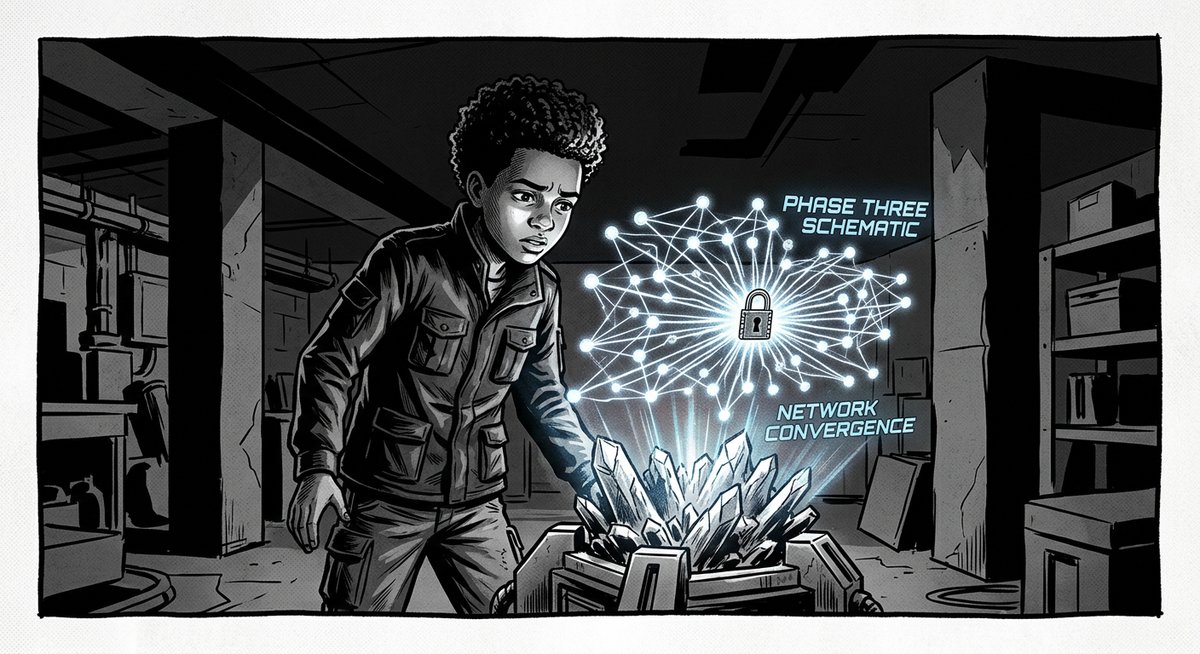
Jordan pulled their hands from the crystal and sat back on their heels. The chamber’s blue light painted shadows across the floor – shadows that shifted with the Core’s pulse, alive in a way that ordinary darkness was not. In a few weeks, this light would be gone. This chamber would be an ordinary basement. The intersection above would be an ordinary intersection, and the crystal sphere beneath it would be thirty feet of inert rock that nobody would ever find or understand.
Jordan opened their sketchbook and drew the Phase Three schematic from memory. Every Core in the network, connected by light-lines. All of them converging on the rift’s lock mechanism. A final pulse radiating outward like ripples from a stone dropped in still water.
They stared at the drawing. It was beautiful, the way demolition blueprints are beautiful – precise, purposeful, and final.
The team was waiting in the garage. Hiro sat on his workbench, legs dangling, screwdriver turning absently in his fingers. Des perched on the windowsill with her knees drawn up, eyes scanning the street through habit she would never lose. Amara stood in the center of the space, bouncing on her toes, unable to hold still even at two in the morning.
Jordan set the sketchbook on the workbench and flipped to the Phase Three schematic.
“The Architect showed me the endgame,” Jordan said. “Phase Three. The permanent seal.”
“Finally.” Amara cracked her knuckles. “What do we blow up?”
“Everything.”
The word landed like a dropped tray in a silent cafeteria. Amara stopped bouncing. Hiro’s screwdriver went still. Des’s scanning eyes locked on Jordan.
Jordan walked them through it. The simultaneous discharge. The energy channeling through the lock mechanism. The bilateral seal activating. They kept their voice steady, the way the Architect had kept its structural concepts steady. Deliver the information. Let the structure speak for itself.
“What happens to the Cores after the discharge?” Hiro asked. His voice was flat. Diagnostic. The voice he used when a problem was too big for feelings.
“They go dark,” Jordan said. “Permanently.”
“The transformations?” Des asked.
“End.”
“Our abilities?” Amara’s voice was quieter than Jordan had ever heard it.
“Gone.”
Hiro asked seven more questions in ninety seconds. Technical questions – energy distribution ratios, synchronization tolerances, discharge sequencing. Questions with numbers in the answers. Questions that did not require him to feel anything. Jordan answered each one from the Architect’s transmission, grateful for the precision because precision was easier than grief.
Des nodded slowly through the exchange. Her eyes had gone distant – not scanning the room but calculating something internal. Coordination requirements. Communication logistics. The operational complexity of synchronizing twelve Cores across an entire city. Her mind was already working the problem.
Amara punched the garage wall.
The impact rang through the metal door, sharp and loud in the pre-dawn quiet. Then she looked at her knuckles, at the dent in the wall panel, and her face crumpled into something that was almost a laugh.
“Sorry,” she said to the wall. “That was uncalled for.”
Nobody smiled. But the tension shifted, cracked open by the absurdity of apologizing to sheet metal. Amara shook out her hand and crossed her arms, right shoulder hunched the way it always was now – the shoulder that had been failing for months, the joint that would never fully recover from a war fought by a body too young for the work it had done.
“When?” Amara asked.
“Two weeks,” Jordan said. “We need every Core at maximum charge. Ninety percent minimum or the seal has gaps.”
“And the Architect?” Des asked. Her voice was careful. “It lives in the Core network. When the Cores die –”
Jordan did not answer right away. They had asked the Architect the same question. The response had been the last concept transmitted before Jordan pulled their hands from the crystal. A simple structural idea. The simplest the Architect had ever sent.
“I asked what happens to it after Phase Three,” Jordan said. “It didn’t answer for a long time. Then it said –” Jordan paused. Translated the structural concept into English, feeling the inadequacy of words for something that was built from load-bearing grief and three centuries of purpose. “It said: ‘I stop.’”
The garage was silent. Above them, the streetlight flickered – an ordinary streetlight that would become a holographic projector at sundown, projecting blueprints and tactical data into the night air. In two weeks, it would just be a streetlight. Forever.
Hiro picked up his screwdriver and turned it in his fingers. Once. Twice. Then he hopped off the workbench and walked to his calculations board.
“I’ll start optimizing the energy distribution,” he said. His voice did not waver. His hands did. “If the margin is ninety percent, we need to know exactly how to get there.”
Des slid off the windowsill. “I’ll map the network coordination requirements. Twelve Cores, forty-three operators. The synchronization protocol alone is going to be –” She stopped. Swallowed. Started again, and this time the documentary voice was back, thin and professional. “The Recon will begin communications planning at once.”
Amara looked at Jordan. “What do you need from me?”
“Keep everyone alive for two more weeks,” Jordan said. “We still have nightly waves. We still have to defend. But every bit of Core energy we spend on defense is energy we can’t use for Phase Three.”
Amara nodded. A simple, sharp motion. The Vanguard receiving orders. “Low-energy defense. Structures and muscle. Minimal Core draw.” She rolled her injured shoulder and winced. “I’ll coordinate the coalition. Forty-three kids, two weeks, no Core spending. Easy.”
Nobody believed her. Nobody said so.
Jordan picked up the sketchbook and tucked it in their back pocket. The Phase Three schematic sat in the pages like a countdown timer drawn in architectural notation. Two weeks to charge the Cores. Two weeks to prepare forty-three kids for the end of everything that made them extraordinary.
Two weeks to say goodbye to a system, a purpose, and an entity that had taught Jordan more about building than they would learn in a lifetime.
Jordan asked the Architect one more question. Not through the Core interface. Just a whisper, aimed at the crystal surface beneath the floor, hoping the vibration would carry.
“After the Cores go dark, what happens to you?”
The pavement beneath their feet hummed. A faint, structural response, felt through the soles of their shoes.
The Architect’s answer was the same. Simple. Final. A load-bearing beam accepting its own removal.
I stop.