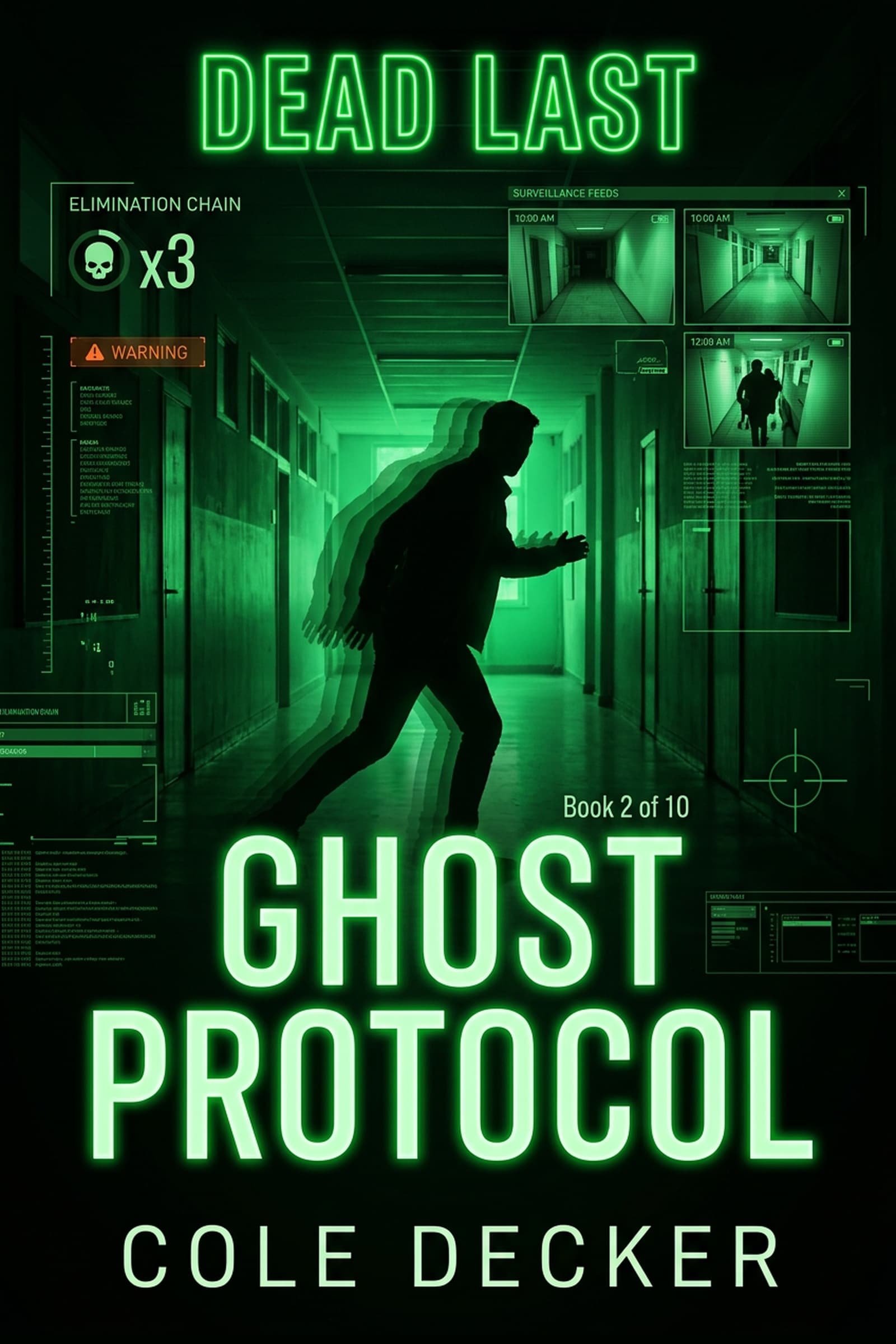
Chapter 1: New Rules
The glasses are different.
I put them on at 6:48 a.m. in the bathroom, two minutes before I leave for school, same routine I’ve followed for fourteen days straight. Same unremarkable wire frames. Same faint weight on my nose. Same click as the arms settle behind my ears.
But the HUD that blooms across my vision is not the same.
The old interface was simple. Attention fields in pale blue, fanning out from every person like flashlight beams. Noise circles expanding and contracting with footstep weight and voice volume. Shadow zones in gray gradient, rated from zero to a hundred. Clean. Functional. A stealth game rendered in geometry.
This is something else.
The overlay shimmers, recalibrates, and rebuilds itself from the ground up. New elements snap into place like puzzle pieces I didn’t know were missing. The sight cones are still there, but they’re sharper now, more detailed – I can see the difference between focused attention and peripheral awareness, rendered as a solid core with a translucent fringe. Sound radii have gained texture. I can distinguish footstep signatures from ambient noise, each one tagged with a tiny frequency label.
And then there’s the heat.
Fading orange footprints on the bathroom tile. Two sets. One fresh – mine, from thirty seconds ago, still glowing bright. One older, dimmer, dissolving at the edges. Someone was standing in this exact spot maybe five minutes ago. Mom, probably. But the point isn’t who. The point is that I can see where people have been.
The HUD is showing me the past.
[SYSTEM] TIER TWO INTERFACE — ACTIVE. NEW FEATURES UNLOCKED: Heat Signature Tracking: 30-second trail decay. Proximity Alert System: Rear-approach warning, 15-foot radius. Challenge Menu: 3 REQUIRED. 1 FAILURE = DESCENT.
I read it twice. Three times.
Challenge menu. I focus on the bottom-right corner of the display, and a translucent panel slides into view.
TIER TWO CHALLENGES: 1. Eliminate a target ranked above you. 2. Execute a chain of 3+ eliminations in a single period. 3. Remain undetected for an entire school day (8 hours, zero detection events). TIME REMAINING: 14 DAYS.
These aren’t survival objectives. Tier One was survival – stay in the game, avoid elimination, learn the rules, don’t get tagged. These are skill tests. Specific, measurable, demanding. The game isn’t asking me to survive anymore.
It’s asking me to prove I’m good at this.
I take the glasses off. Put them in my jacket pocket. Stare at my own face in the bathroom mirror – pale skin, mousy brown hair falling across my forehead, the kind of face that people forget while they’re still looking at it.
Eighty-nine. That’s my rank. Out of the twenty-three players who survived the first round, I’m somewhere in the middle. Not the best. Not the worst. Not dead last anymore, but not anywhere close to the top.
Two weeks ago, I found these glasses in the lost and found. Two weeks ago, I didn’t know I was playing a game. Two weeks ago, I was invisible because nobody cared enough to look.
Now I’m invisible because I’m good at it. And the game wants me to get better.
I pocket the glasses and head downstairs. Mom is in the kitchen, pouring coffee, her back to me. She doesn’t turn around. Her sight cone – and yes, I think about my own mother in sight cones now, which is either a sign that the game has improved my awareness or destroyed my social skills – is aimed at the coffee maker. I pass through the kitchen like a draft of cold air. Grab my backpack from the hook by the door. Open the front door.
“Have a good day, Nadia,” she says, still not turning.
“You too, Mom.”
She doesn’t ask about school. She doesn’t ask about friends. She doesn’t ask because she’s tired and busy and I’ve spent thirteen years giving her no reason to think anything interesting is happening in my life. Which, until two weeks ago, was accurate.
The walk to school takes eleven minutes. I count the shadows out of habit – the oak tree on Maple Street (natural concealment, shadow rating: probably 60), the bus stop alcove on Third Avenue (built-in blind spot, shadow rating: 45), the loading dock behind the grocery store (shadow rating: 70, but only before nine a.m. when the delivery trucks block the sight lines). The world is a stealth map now. Every surface has a rating. Every corner is an opportunity or a threat.
I’m not sure when this started feeling normal. But it does.
The team meets at the library before first bell. Our table. Third from the back, left side. The table nobody else wants because it’s behind the encyclopedia shelf and the overhead light flickers every forty seconds.
Shadow rating: 78. Our fortress.
Diego is already there, feet up on the chair next to him, wearing a shirt that says PROFESSIONAL CHAOS CONSULTANT in blocky letters. He’s drumming his fingers on the table in a pattern that I’ve learned to recognize as nervous energy. Fast drumming means he’s excited. Slow drumming means he’s thinking. This is fast.
“Your HUD updated too?” I ask.
“I don’t have a HUD. I have instincts.” He taps his temple. “But my instincts are telling me something changed. The hallways feel different this morning. People are moving in new patterns. Three kids who always take the east stairwell switched to the west one. Two teachers changed their morning patrol routes.” He leans forward. “Something shifted.”
Diego doesn’t have glasses. None of them do. But Diego doesn’t need augmented reality to read attention patterns. He’s been doing it his whole life – tracking who’s looking at what, where eyes go when someone enters a room, the invisible currents of attention that flow through any group of people. The HUD just confirmed what he already knew.
Eunji arrives at 7:01. She sits, opens her notebook – the battered black-and-white composition book, fourth volume, held shut with a rubber band – and flips to a page that’s already half-filled with her small, precise handwriting.
“I have a hypothesis,” she says, instead of hello.
“Good morning to you too,” Diego says.
Eunji doesn’t acknowledge this. “The ranking distribution from the first round follows a tiered structure. The top ten players – all Tier Three or above, based on their elimination patterns. Players ranked eleven through fifty – Tier Two. Players ranked fifty-one through one hundred – transitional. Players ranked below one hundred who survived – anomalies.”
“I’m an anomaly?” Diego asks.
“Everyone at this table is an anomaly.” She adjusts her glasses – her real ones, rectangular, slightly too large for her face. “The game expects solo players. Teams aren’t in the design. We broke the expected model, and the system is adjusting.”
“Adjusting how?”
Eunji taps her notebook. “That’s what I’m trying to figure out.”
Marcus arrives at 7:06. Late, by his standards. He squeezes into the chair at the end of the table, and the chair protests but holds. He has a granola bar in each hand.
“Four in the backpack,” he reports. “Two in hand. Emergency reserves restocked.”
“You went shopping,” I say.
“Costco.” He unwraps a bar and takes a bite. His stress level reads as moderate – not the calm of the post-surge celebration, but not the tight-jawed anxiety of the final days. Something in between. Watchful. “The hallways are weird this morning. Did anyone else notice?”
“Diego noticed,” I say.
“The patterns shifted,” Diego confirms. “New routes. New timing. Like someone reshuffled the deck.”
I put the glasses on. The library fills with the Tier Two overlay. Ms. Osei at her desk, sight cone focused on her computer screen. Two students in the far corner, their heat signatures warm and steady – they’ve been sitting there for at least ten minutes. The shadow zones pulse with their familiar gradients, but now there’s a new layer underneath: fading thermal footprints on the carpet, showing the traffic patterns of the last half hour.
“The HUD upgraded,” I tell them. “Tier Two interface. New features.” I describe the heat signatures, the proximity alert, the challenge menu. I watch their faces as I talk.
Diego’s eyes light up. New mechanics means new strategies. New strategies means new distractions. He’s already calculating.
Eunji is writing. Every word I say goes into the notebook, transcribed in her neat hand with annotations in the margins. She’ll have a full analysis by lunch.
Marcus chews his granola bar and listens. When I finish, he asks the question that matters. “What happens if you fail a challenge?”
“Descent,” I say. “The system didn’t specify what that means.”
“It means you drop tiers,” Eunji says. “Based on the ranking structure, a tier descent would reset your rank to the bottom of Tier One. Possibly lower. The system is incentivizing aggressive play.”
Silence. Diego stops drumming.
“So we have to go on offense,” he says.
“We have to go on precise offense,” I correct. “The challenges are specific. This isn’t about surviving anymore.”
Eunji looks up from her notebook. “Tier One tested whether you could play the game. Tier Two tests whether you should be playing.”
I look at the challenge menu one more time. Three challenges. Fourteen days. Fail one and descend. Complete all three and advance.
But there’s something else. Below the three challenges, a fourth entry. Greyed out. Locked. The text pulses faintly, like a heartbeat.
SPECIAL CHALLENGE: ASSIGNED BY THE WARDEN. REQUIREMENTS: UNKNOWN. REWARD: UNKNOWN. STATUS: LOCKED.
And below it, in text so small I have to squint:
THE WARDEN IS WATCHING.
I take off the glasses. My team is looking at me. Three people who chose to see me, who chose to stay in a game that rewards solo play, who are sitting at a table in a library fortress because they trust me to lead them through whatever comes next.
“Fourteen days,” I say. “Three challenges. And something the Warden hasn’t told us about yet.”
Diego grins. “When do we start?”
The bell rings. First period. The hallways fill with four hundred students who have no idea they’re pieces on a board that just got more complicated.
I stand up. Check the shadow rating. 78. Safe.
But not for long.