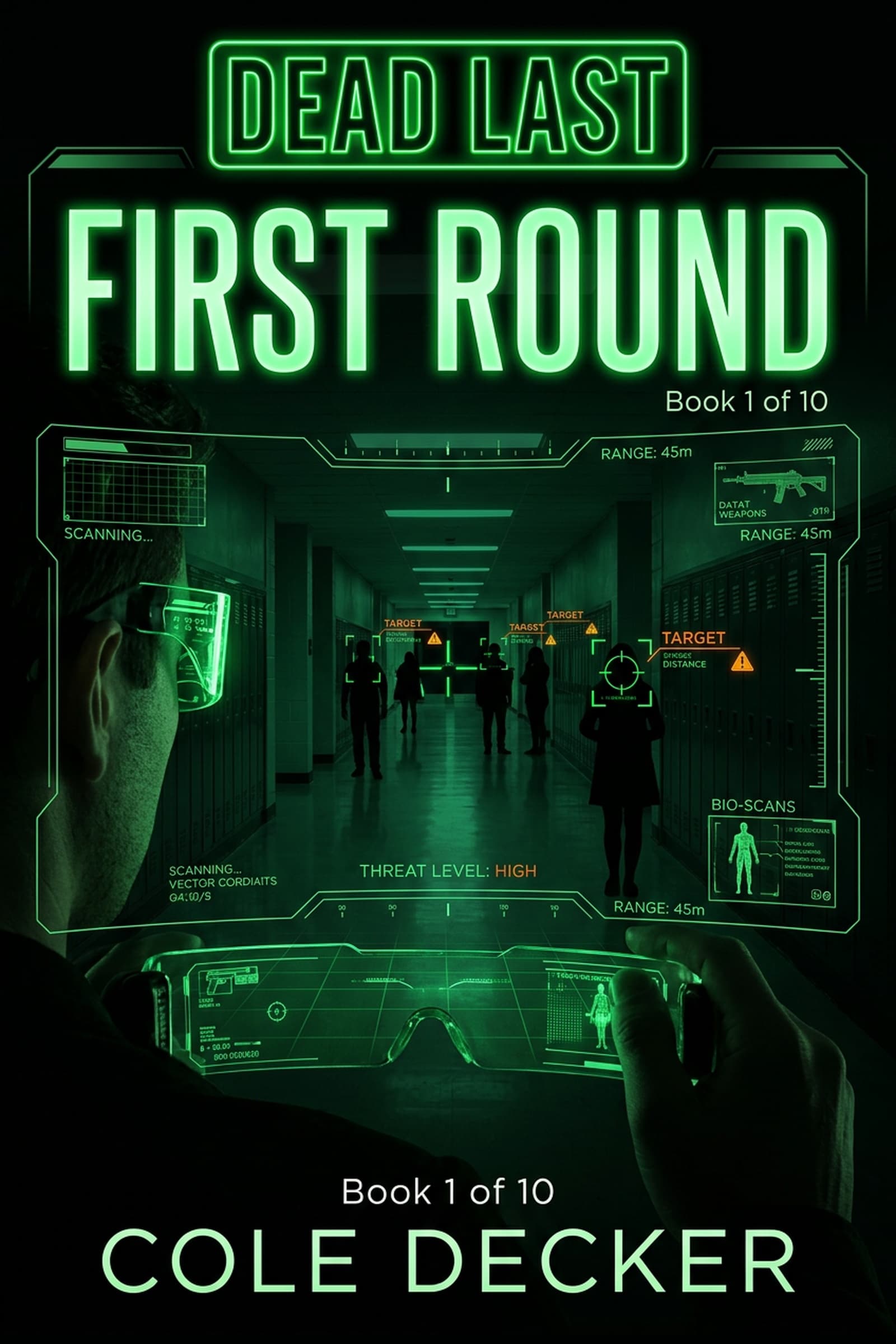
Chapter 1: Lost and Found
The secretary doesn’t know my name.
I’ve been sitting in this chair for six minutes, watching her flip through the roster with one finger, and she’s already passed the V section twice. Volkov. It’s right there, between Underwood and Watson, same as it’s been all year. But her eyes slide over it the same way everyone’s eyes slide over me – like I’m a smudge on the glass that isn’t worth cleaning.
“Nadia,” I say, for the third time. “Volkov. V-O-L-K-O-V.”
“Right, right.” She finds it. Smiles the way adults smile when they’re embarrassed but won’t admit it. “Lost and found is in the bin by the door, sweetie. Help yourself.”
I don’t correct her. I don’t tell her I’ve been in this school for two and a half years and she’s processed my attendance forms forty-seven times. I just nod and walk to the bin.
My jacket isn’t lost. I know exactly where it is – shoved into the plastic bin under three somebody-else backpacks and a single sneaker that has been in there since September. I know this because I notice things. I notice everything. It’s what happens when nobody notices you.
The office is busy today. Two kids wait for the nurse – one holding an ice pack to his elbow, the other faking a stomachache with an expression that wouldn’t fool a first-grader. A parent argues about a parking ticket through the front window, her voice sharp enough to cut the hum of the ancient heater. Mr. Donnelly from guidance walks through with a coffee cup, fourth one today based on the ring stains on his desk blotter that I cataloged when I was in his office pretending to care about a career aptitude survey. He takes the same route every time – door, coffee station, hallway, left turn. Fifteen steps. I’ve counted.
The ice-pack kid shifts his weight. The stomachache faker glances at the clock – 11:47, which means she’s trying to skip the last fifteen minutes of pre-algebra. The parent at the window taps her fingernails on the counter in groups of three. Everyone in this room has a pattern, a tell, a rhythm they don’t know they’re broadcasting.
Nobody watches me watch them. That’s my pattern. That’s my tell. The girl who sees everything and is seen by nothing.
I dig through the bin. My jacket is exactly where I thought it was, wedged under a backpack with a broken zipper. I pull it free, and something clatters against my hand.
A pencil case. Hard plastic, scuffed at the corners, no name on it. The kind of generic case you’d find in a dollar store bin. I pop it open. Inside, there’s a pair of thin wire-frame glasses. They look like the kind the librarian wears – light, simple, almost invisible. The frames are dark gray, thin as piano wire. The lenses catch the office light and flash something that might be a reflection or might be something else entirely.
I don’t wear glasses. My vision is fine. Twenty-twenty, confirmed at the school eye screening three months ago when the nurse also forgot my name.
But something about these feels different. The weight is wrong – too light for real lenses, too heavy for plain glass. I turn them over in my hands. The hinges move smoothly, like they’ve barely been used. No scratches. No smudges. They look new inside a case that looks old, which makes no sense unless someone put them here on purpose.
I glance around the office. Nobody is watching me. Nobody is ever watching me.
I put the glasses on.
The world splits in two.
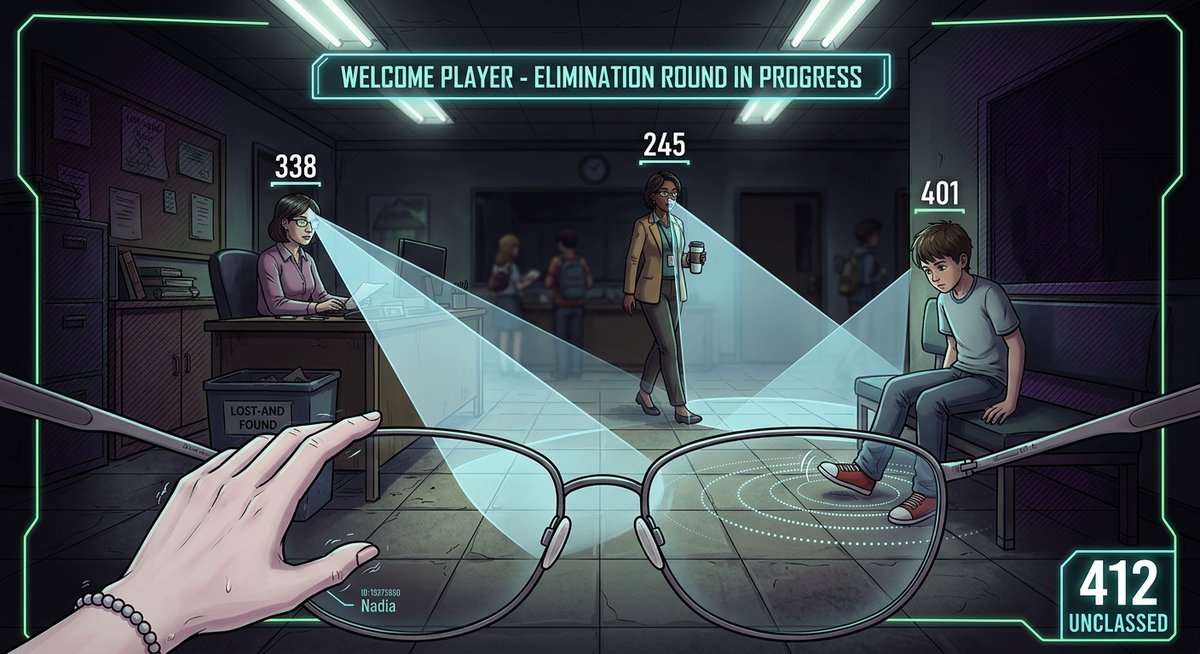
The office is still there – same fluorescent lights buzzing their sixty-hertz drone, same tile floor with the crack near the door, same secretary ignoring me. But layered on top of it, like a transparency sheet pressed over a textbook illustration, there’s something else. Geometric shapes. Numbers. Fields of light radiating outward from every person in the room.
The secretary has a cone of light extending from her face, sweeping slowly left to right. It reaches about eight feet, spreading wider the farther it gets, like a flashlight beam projected onto the floor. When the cone passes over the kid with the ice pack, the kid’s outline pulses faintly. When the cone sweeps away, the pulse stops.
The parent at the window has a cone too. Narrower. Focused on the parking attendant outside. It doesn’t move.
Mr. Donnelly’s cone is wide and lazy, drifting across the room without locking onto anything. It sweeps past me. Nothing happens. I’m outside its range by two feet, standing in a dim patch between the bin and the wall where the overhead light doesn’t quite reach.
Every person has a circle on the floor around their feet. The kid tapping his shoe against the chair leg has a big one – maybe ten feet across, pulsing with each tap, each ring expanding outward like a ripple in a pond. Tap. Ripple. Tap. Ripple. The secretary’s circle is smaller, maybe four feet, a quiet hum of ambient presence. The parent’s is almost invisible.
Numbers float above each person’s head. Small, clean, white text on nothing – hovering in the air like subtitles for a world that forgot to turn them off. The secretary: 338. Mr. Donnelly: 245. The tapping kid: 401.
I look toward the window. My own reflection stares back at me, brown hair falling in my face as usual, glasses sitting on my nose like they belong there. And above my reflected head, a number.
Below my rank, a small label: UNCLASSED.
At the top of my vision, a banner blinks. Clean text, no decoration, like a notification from a phone I don’t own:
[SYSTEM] WELCOME, PLAYER. ELIMINATION ROUND IN PROGRESS.
My hands go cold. Not cool. Cold. Ice-pack cold. The kind of cold that starts in your fingertips and works inward toward your chest.
I take the glasses off. The overlay vanishes. The office is just an office. Fluorescent lights, tile floor, a secretary who still hasn’t looked up.
I put them back on. The overlay returns. Cones. Circles. Numbers. The banner still blinking.
I take them off again. Normal.
On. Not normal.
Off. The world I know.
On. The world underneath it.
My heart is hammering. I fold the glasses carefully, handling them like they might shatter or detonate, and slip them into the pencil case. I slide the case into my jacket pocket, zip the pocket shut, and pat it once to make sure it’s secure.
I pick up my jacket. I walk out of the office. My footsteps are silent on the tile, the way they always are. I don’t scuff. I don’t stomp. I’ve been walking quietly since I learned how to walk, because quiet people don’t attract attention, and attention has never been something I wanted.
The secretary doesn’t say goodbye. She doesn’t notice me leave. For the first time in my life, I’m grateful for that.
The hallway outside the office is the usual post-lunch chaos. Kids moving in clusters, shouting over each other, backpacks swinging. Someone’s playing music from a phone speaker. Someone else is laughing at a volume that could shatter glass. The hallway is a river of noise and motion and bodies, and I’m a rock at the edge that the current flows around without touching.
I press my back against the wall near the water fountain and pull the glasses out.
I put them on.
The hallway transforms. Sight cones everywhere – overlapping, sweeping, creating a maze of visible and invisible space. Some cones are wide and lazy, drifting without purpose. Some are narrow and focused, tracking a specific person down the hall. The floor is covered in pulsing circles – sound radii, I’m guessing. Every footstep, every laugh, every locker slam generates a ring that expands outward like a sonar ping.
And the numbers. Every kid has one floating above their head like a price tag at a store that sells human beings. Some in the two hundreds. A few in the three hundreds. The popular kids – Tyler Morrison and his crew, walking four-wide down the center of the hallway like they own the deed – are in the low hundreds. Tyler’s number reads 34.
I check my own reflection in the trophy case glass.
412 out of 412.
Dead last.
My gaze drifts to the spaces between the cones. There’s a pocket of darkness behind the stairwell door – no cones reach it, no sound radii overlap it. A small number hovers in the shadow: 72. Some kind of concealment rating. Another dark zone sits underneath the trophy case itself. Rating: 58. A third one fills the gap between two classroom doors where the overhead light is burnt out. Rating: 64.
These are the spots I already know. The places I’ve been standing for two years, without knowing why they felt safer than everywhere else. The glasses just gave them numbers.
I look down the hallway. The cones sweep back and forth. The radii pulse. The numbers float. Somewhere in this crowd, four hundred and eleven other players are ranked above me, living their normal lives, eating their normal lunches, having their normal conversations. None of them see the layer underneath.
None of them know they’re playing.
I slip the glasses off and tuck them away. My hands are shaking, but the rest of me is perfectly still. On the outside, I’m a girl standing by the water fountain, waiting for the crowd to thin. Invisible. Unremarkable. Dead last.
On the inside, I’m trying to figure out what kind of game drafts an entire school without asking.
And what it means that I’m dead last in a game I didn’t sign up for.
My pocket buzzes. Not my phone – I don’t have one. The glasses. I pull them out just enough to see the lenses. A notification scrolls across the glass, visible even folded:
NEAREST TARGET: 14 feet | ELIMINATION WINDOW: OPEN