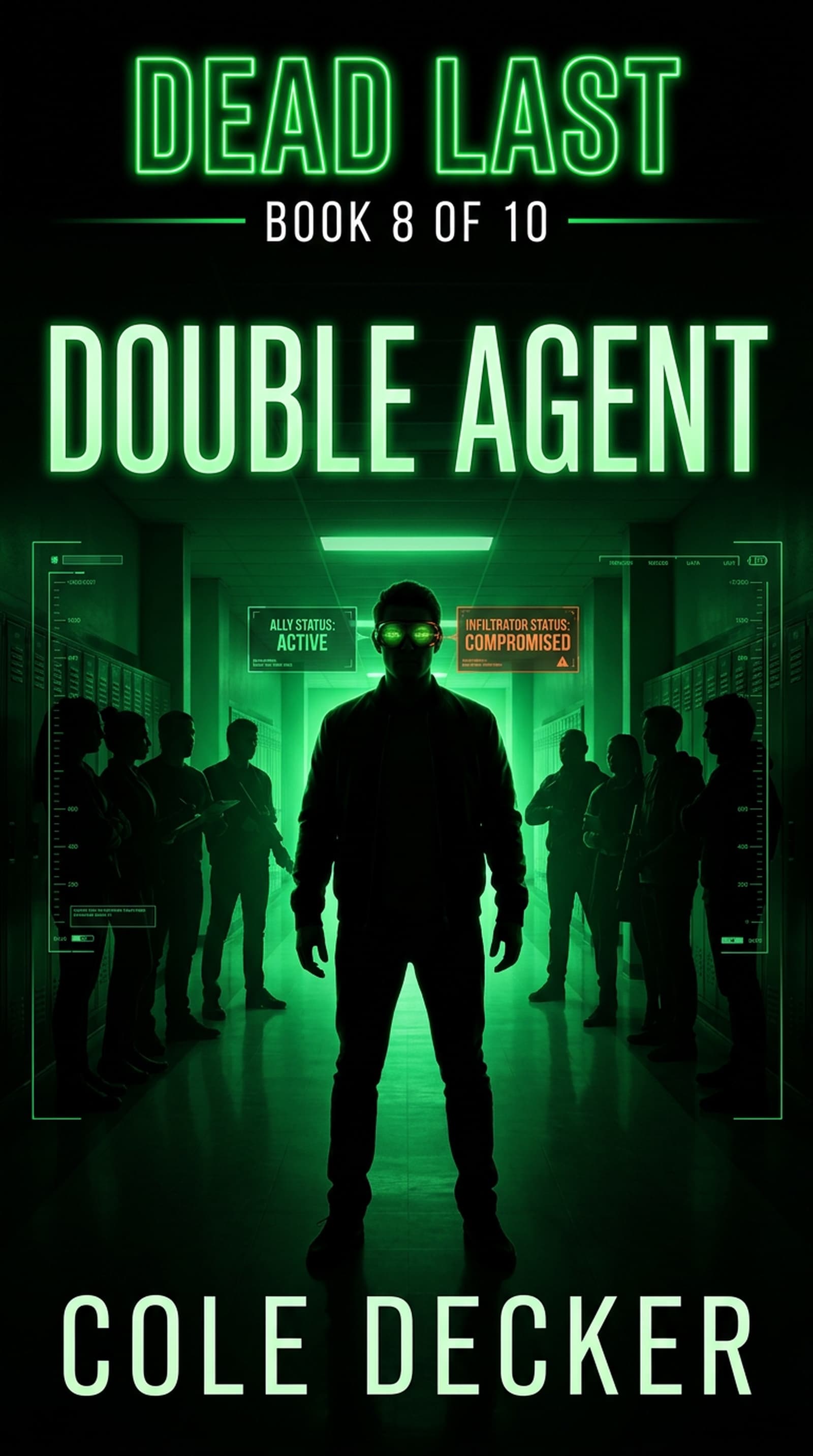
Chapter 1: “Cover Story”
The cafeteria at Westbrook is a kill zone. Shadow rating: 12. Three hundred students packed into a room with fluorescent lighting and no blind spots. Every seat is exposed. Every conversation is public.
Today, that’s the point.
Diego stands across from me at our usual table. His hands are on his hips. His voice is cranked to performance volume – the full Diego, dialed past ten into territory usually reserved for fire drills and surprise birthday parties.
“You’re a COWARD, Nadia!”
Every head turns. Every sight cone in the room pivots toward our table like searchlights finding a prison break. The attention heat map on my HUD goes solid red – four hundred eyeballs locked onto two seventh-graders having the loudest argument in Westbrook history.
I feel my skin crawl. Visibility is my enemy. It has been since the glasses first showed me what invisibility was worth.
But this isn’t real.
This is the most important performance Diego has ever given, and he doesn’t even know how much of it is acting.
“The Warden is USING you!” Diego shouts. He slams his palm on the table. The sound radius blooms outward on my HUD – forty feet, easy. Teachers are looking. Mrs. Kominski has already started moving from the faculty table. “She’s been protecting her precious pet project while the rest of us get GROUND UP by Phase Two. Three tags a day? My little brother is crying in the hallways because some eighth-grader keeps tagging him for quota points, and you won’t DO anything about it!”
The words hit harder than they should. Because they’re true. Not the coward part. Not the pet project part. But Marcus told me about the sixth-graders. Eunji’s data confirmed it. Phase Two is hurting players who don’t know they’re playing, and I haven’t stopped it.
I lean into the script. “You don’t know what you’re talking about.”
“I know you care more about your rank than your friends!”
The cafeteria is dead silent. Three hundred people watching. The HUD’s social overlay – a feature I’ve been ignoring for seven books – paints the room in gradients of attention intensity. We’re the center of everything. Every student, every teacher, every camera in the room is pointed at this table.
Good. If anyone from the organization is monitoring cross-school communications, they’ll see exactly what we want them to see: Nadia Volkov’s team falling apart.
Diego grabs his tray. Throws his uneaten pizza slice into the trash with maximum drama. Storms toward the exit. He passes Marcus, who is standing by the door with a granola bar frozen halfway to his mouth and genuine confusion on his face.
Marcus doesn’t know the fight is staged. We couldn’t tell him. Marcus can’t lie. His face broadcasts every emotion like a billboard. If Marcus thinks the fight is real, it looks real.
“Diego, wait –” Marcus reaches out.
Diego shoves past him. Gone.
The cafeteria buzzes with whispered reactions. I feel them the way you feel a change in air pressure – the social atmosphere shifting, recalculating, adjusting to the new information that Nadia Volkov’s crew just cracked down the middle.
I sit back down. Push my tray away. Play the part.
Eunji slides into the seat next to me. Her notebook is open. Her pencil is still. She’s the only other person who knows what just happened, and her face gives away nothing. Eunji could watch the apocalypse and take notes.
“Convincing,” she murmurs. “His micro-expressions were consistent with genuine anger. Either he’s a better actor than I profiled, or parts of that were real.”
“Parts of it were real.”
She looks at me. The analytical look. The one that means she’s recalculating a profile she thought was complete.
“The parts about the sixth-graders,” she says. It’s not a question.
“Yeah.”
She writes something in the notebook. I don’t ask what.
Three hours later, I’m in the library with Ms. Osei. Room B-14. The door is locked. The cameras in this room are on a loop she controls – twelve minutes of empty footage, repeating.
Ms. Osei sits behind the desk with the Warden’s glasses folded in front of her. She looks tired in a way that has nothing to do with sleep. Twenty-five years of running a game that has been ripped out of her hands in six weeks.
“The transfer paperwork is ready,” she says. She slides a folder across the desk. Inside: registration documents for Northridge Middle School’s game system. Player ID. Class designation. Transfer authorization stamped with a Warden signature that isn’t hers – it’s Mr. Hale’s, the Northridge Warden, forged by Priya from a signature sample Eunji pulled from district records.
“Your cover story,” Ms. Osei continues. “Nadia Volkov. Disillusioned with Westbrook’s Warden. Frustrated with Phase Two’s enforcement. Looking for a program that takes the game seriously.”
“That’s barely a cover story. It’s basically true.”
“The best covers always are.” She removes her regular glasses – the beaded chain, the reading lenses, the warm librarian costume – and rubs her eyes. “Nadia. I need you to understand what I’m asking you to do.”
“Infiltrate Northridge. Map their infrastructure. Identify how Calloway is interfacing with their Warden. Report back.”
“That’s the mission. I’m asking about the cost.” She puts her glasses back on. “You’ll be alone. In an unfamiliar building with unfamiliar players and a Warden who cooperates with the organization willingly. Your team won’t be there. Diego just publicly declared you a coward in front of three hundred witnesses. Marcus thinks the fight is real. You are about to be the loneliest you’ve been since before you found the glasses.”
The words settle like cold water. She’s right. The glasses gave me a team. The team gave me something I didn’t have a word for until I almost lost it. Connection. Belonging. The feeling of being invisible by choice instead of by default.
I’m about to give all of that up. Temporarily. Strategically. For the mission.
“I can do this,” I say.
“I know you can. That’s not what I asked.”
I meet her eyes. “I know the cost.”
She holds my gaze for three seconds. Then she nods.
“Priya will be your courier. Dead drops only – no digital communication, nothing the organization can intercept. She’s the only team member who hasn’t been publicly associated with you.” Ms. Osei slides a second document across the desk. “Your game registration transfers at midnight. Tomorrow morning, you walk through Northridge’s front doors as a new player.”
I pick up the folder. The paperwork feels heavier than paper should.
“One more thing,” Ms. Osei says. “The HUD will recalibrate when you enter Northridge’s system. New zone maps. New player databases. New sight cones. Everything you memorized at Westbrook – every patrol route, every shadow zone, every ghost path – will be useless. You’ll be starting from zero.”
Starting from zero. The phrase sends a spike of cold down my spine. I spent months mapping Westbrook. I know every blind spot, every camera angle, every teacher’s patrol timing down to the second. That knowledge is my armor. Without it, I’m just a kid in a new school, trying not to be seen.
Which is exactly what I was before the glasses.
Maybe that’s the point.
Tuesday morning. 7:47 AM.
Northridge Middle School sits on the other side of the district, fourteen minutes by bus. The building is newer than Westbrook – glass and concrete instead of brick and institutional green. Bigger, too. Two stories with a gym wing that extends toward the football field like an arm reaching for something.
I stand at the front entrance. My backpack is heavy with the transfer folder and three days of clothes. The HUD glasses sit on my face, dormant, waiting.
I push through the doors.
The glasses activate.
The world transforms. Not the familiar blue-green overlay of Westbrook’s system – something harder, faster, rendered in sharper lines. Northridge’s game architecture loads like a new operating system booting up. Zone boundaries appear, cutting the lobby into sectors I don’t recognize. Player profiles populate in rapid succession – names I’ve never seen, threat assessments I can’t contextualize, class designations that mean nothing without weeks of observation to back them up.
SYSTEM TRANSFER COMPLETE. Player: Nadia Volkov. Class: Phantom. Transfer origin: Westbrook MS. New assignment: Northridge MS. Zone data loading. Player database: 387 contacts. Known profiles: 0. Shadow map: INCOMPLETE. Ghost paths: UNAVAILABLE. Familiarity index: 0%.
Zero percent. Every number on my HUD is a confession of ignorance. I don’t know where the cameras are. I don’t know the patrol routes. I don’t know which hallways are dead zones and which ones are safe. The ghost paths – the optimal stealth routes the HUD calculates based on accumulated zone data – are blank. The system needs time to learn this building.
So do I.
Students stream past me. New faces. New sight cones. New sound radii overlapping in patterns I can’t read yet. A tall kid with a letterman jacket brushes my shoulder – not a tag, just carelessness – and my heart rate spikes before the HUD confirms: no elimination intent detected.
I’m jumping at shadows. In a building where I don’t even know where the shadows are.
The lobby opens into a main corridor that splits in two directions. Left leads toward what the HUD labels ACADEMIC WING – classrooms, lockers, the standard school infrastructure. Right leads toward GYM COMPLEX. Straight ahead, through a set of double doors, is the cafeteria.
Everything is wrong. The proportions. The lighting. The way sound bounces off the concrete walls instead of absorbing into Westbrook’s old plaster. My internal map – the one I built over months of observation, the one that exists in my muscles and my instincts as much as in my memory – is screaming that nothing is where it should be.
I take a breath. I catalogue.
Three exits visible from the lobby. Cameras at the northeast and southwest corners – different models than Westbrook’s, mounted higher, wider angle. The shadow rating in the lobby is a flat 8 – worse than Westbrook’s cafeteria, which I didn’t think was possible.
A boy slams his locker twenty feet to my left. The sound radius blooms on my HUD. Huge. The lockers here are metal, not the dampened composite Westbrook installed five years ago. Everything is louder.
I’m starting from zero. In a building that wants me to fail.
The HUD pulses with a new notification. Not from Ms. Osei’s familiar format. Not from the organization’s cold gray. Something local. Northridge’s system.
WELCOME, TRANSFER PLAYER. Report to gymnasium for orientation. 8:00 AM. Attendance mandatory. Warden Hale presiding.
Warden Hale. The PE teacher. The Warden who cooperates with Calloway because he thinks the recruitment pipeline is the game’s purpose, not its corruption.
I shift my backpack. Check the time. Thirteen minutes to learn a building that wants to eat me alive.
I start walking. The HUD tracks my movement, building zone data with every step. Incomplete. Fragmented. A map drawing itself one footprint at a time.
Behind me, the front doors close. Westbrook is fourteen minutes and an entire identity away.
Ahead of me, Northridge waits.
And somewhere in this building, a Warden I’ve never met is about to welcome me into a game I’m planning to betray.