Chapter 1: Away Game
The bus smells like diesel and old vinyl and the faint chemical sweetness of someone’s body spray three rows back.
I hate buses.
Not because of the smell or the noise or the way every seat feels like it was designed for someone six inches shorter than a human being. I hate buses because they’re mobile fishbowls. No shadow zones. No concealment. Every passenger visible from every angle. The windows are transparent observation panels, and the aisle is a kill corridor with zero cover.
Shadow rating of a city bus: four. Maybe five if you slouch.
I’m not slouching. I’m sitting in the third row from the back, left side, window seat, with my HUD glasses on and my heart hammering so hard I can feel it in my teeth.
Beside me, Diego bounces his knee. Behind us, Marcus takes up a seat and a half and eats his second granola bar of the morning. Across the aisle, Eunji writes in her notebook with a pen that hasn’t stopped moving since we boarded. Kai sits alone in the back row, glasses on, face unreadable, scanning data streams I can’t see.
We’re on a city bus headed northeast. Destination: Lincoln Middle School. Mission: reconnaissance for District Play.
And I’ve never been more out of my depth.
The HUD updated this morning. The District Play interface – loaded six months ago but dormant until today – activated at exactly 7:00 AM with a notification that made my glasses vibrate against my nose.
[SYSTEM] DISTRICT PLAY: ACTIVE.
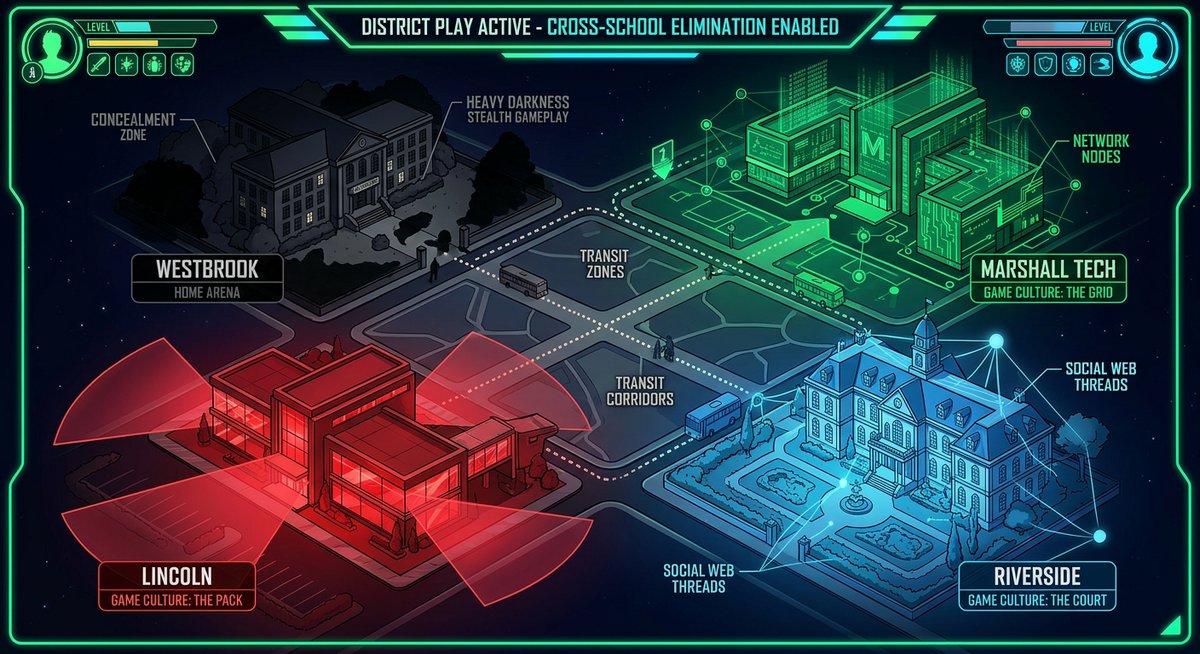
Arena expansion: 4 schools registered. Transit corridors: ENABLED. Bus routes, walking paths, shared parks designated as neutral zones. Cross-school elimination: ACTIVE. Triple point value. Home arena: Westbrook Middle School. Away arenas: Lincoln Middle School, Riverside Academy, Marshall Tech Magnet. Objective: Complete designated challenges at each rival school. Earn cross-district ranking points.
Four schools. Three away arenas. Hundreds of players I’ve never profiled, in buildings I’ve never mapped, running game mechanics I’ve never seen.
At Westbrook, I know every shadow zone, every sight cone pattern, every patrol route. I know that Mr. Henderson checks the east hallway at 10:15 and that the library’s concealment rating peaks at 78 during fourth period when the overhead lights dim for reading hour. I know my arena the way a spider knows its web – every thread, every vibration, every safe corner to wait.
Lincoln Middle School is someone else’s web. And I’m about to walk into it.
“Okay,” Diego says, leaning forward. “Run me through the plan one more time. I want to make sure I have my motivation clear.”
“Your motivation is survival,” Eunji says without looking up.
“Sure, but what’s my CHARACTER motivation? Am I the charming rogue? The lovable wildcard? The agent of chaos who answers to no one?”
“You’re the distraction.”
“That’s my ROLE. I need a character arc for this performance.”
“Diego.” I keep my voice low. Bus acoustics carry. “Lincoln’s game culture is built on aggressive physical play. Their players move in coordinated packs – three to five per group, sight cones interlocking. They hunt by surrounding targets and closing all exit routes. Stealth doesn’t work there because the building was designed with glass walls and open corridors. Shadow ratings average below thirty.”
Diego stops bouncing his knee. “Below thirty? The cafeteria at Westbrook is fifteen, and that’s basically a death trap.”
“Lincoln is an entire school of cafeterias.”
“Fantastic. Love that for us.”
Marcus leans forward between the seats. The bus groans slightly under the shift. “What about me? Can I bodyblock in glass corridors?”
“The corridors are wider than Westbrook’s. More room for Pack formations. But also more room for you to position.” I pull up the mental map I’ve been building from Eunji’s research – satellite imagery, yearbook photos, architectural details scraped from the school district’s public records. “The main hallway is twelve feet wide. You can block half of it.”
“Half is enough.” Marcus nods. “Half is always enough.”
Eunji tears out a notebook page and passes it to me. A hand-drawn floor plan of Lincoln’s first floor, reconstructed from the data she’s gathered over six months of preparation. Corridors marked in red for high visibility. The few potential concealment points circled in blue – a trophy case near the front entrance, a bank of lockers outside the gymnasium, an equipment storage alcove near the loading dock.
Three blue circles on an entire floor plan. At Westbrook, my ghost path connects dozens of shadow zones in an unbroken stealth route through the entire building. At Lincoln, I have three islands in an ocean of exposure.
“Kai,” I say. “What does the administrative network show for Lincoln?”
Kai’s voice comes from the back row, flat and precise. “Lincoln’s Warden is fully complied. Organization protocols are running unfiltered. Their game is rawer than Westbrook’s – fewer modifications, fewer safeguards, closer to the original system design.” He pauses. “Their elimination rate is three times ours. Players get tagged fast and often. The average Lincoln player lasts six weeks before elimination. At Westbrook, it’s four months.”
Six weeks. The game at Lincoln chews through players like a woodchipper.
The bus turns onto Lincoln’s street. Through the window, the school comes into view, and my stomach drops.
Westbrook Middle School is old brick and narrow windows and deep shadows. It was built in the 1970s when architects apparently believed that natural light was optional and hallways should feel like tunnels. Perfect for a stealth game. Every corner is a hiding spot. Every corridor has shadow zones deep enough to vanish in.
Lincoln Middle School is glass.
Modern architecture. Walls of windows. Open floor plans visible from outside. The building gleams in the morning sun like an aquarium. I can see INTO the hallways from the bus – students moving through corridors that are flooded with light, wide open, nowhere to hide.
I put on the glasses and activate the district HUD.
The overlay loads Lincoln’s zone map. And the data confirms what my eyes already know.
[LINCOLN MIDDLE SCHOOL] Zone mapping active.
Average shadow rating: 22. Maximum concealment zone: Trophy case, main entrance – Rating: 31. Sight cone coverage: 95% of building at any given time. Ghost path generation: FAILED. Insufficient shadow zones for viable stealth route.
Ghost path generation failed.
My primary Phantom ability – the thing that makes me dangerous, the skill that took me from rank 412 to rank 22 – doesn’t work here. The building doesn’t have enough shadow to generate a stealth route. I’m walking into an arena where my best weapon is useless.
“Ghost path failed,” I say quietly.
Eunji looks up from her notebook. “Expected. I noted the architectural incompatibility in my preliminary assessment.” She adjusts her glasses. “You’ll need to operate without your primary ability. That’s why we trained for six months.”
“Training and reality are different things.”
“Which is precisely why we’re doing reconnaissance before the actual competition begins.”
The bus slows. Pulls to the stop across from Lincoln’s front entrance. Through the glass walls of the school, I can see the morning rush – students streaming through the corridors, backpacks bouncing, conversations I can’t hear but can read in the gestures and body language even from here.
Normal kids. Normal school. Except some of them are players. And some of those players are waiting for us.
“Everyone remember the cover story?” I ask.
“Academic enrichment visit,” Eunji says. “Ms. Osei arranged it through the district office. We’re here to observe Lincoln’s STEM program. Legitimate, documented, and completely boring.”
“Diego?”
“I’m enthusiastic about science.” He puts on a face of earnest fascination that’s so convincing I almost believe it. “SO enthusiastic. Can’t wait to see their lab equipment. Is that a Bunsen burner? TELL ME EVERYTHING.”
“Marcus?”
“I’m a quiet student who’s interested in their athletics program.” He straightens in his seat. “Low profile.”
“Your profile is never low, but we’ll work with it.” I look at Kai. “Stay on the administrative layer. Monitor their network. Don’t engage with any Lincoln players directly.”
Kai nods once.
I take a breath. The bus doors open. Diesel exhaust mixes with the cold morning air.
“This is an away game,” I say. “We don’t know the arena. We don’t know the players. We don’t know the rules. The only thing we know is each other.” I stand. “So stay close. Stay smart. And if everything goes wrong, Diego makes noise and we run.”
“Now THAT’S a plan I can work with,” Diego says.
We step off the bus.
My HUD flashes. Three proximity alerts, simultaneous, clustered near the front entrance.
I freeze.
Three Lincoln players are already watching the bus stop. They’re standing in a triangle formation near the main doors, bodies angled outward, sight cones spread wide. They’re not trying to hide their observation. They’re broadcasting it. Three sets of eyes, three overlapping fields of vision, covering the entire approach from the street to the entrance.
They knew we were coming. They’ve been waiting.
And their HUD data shows something I’ve never seen before. The sight cones aren’t independent. They’re linked – interlocking fields of vision that overlap at the edges, creating a continuous wall of visual coverage. No gaps. No blind spots. No sliver of space where a Phantom could slip through unseen.
Pack formation overlays. They don’t move as individuals. They move as a unit.
The wall of sight has no holes.
And we have to walk through it.