Chapter 1: “War Council”
The warehouse smelled like motor oil and nervous sweat.
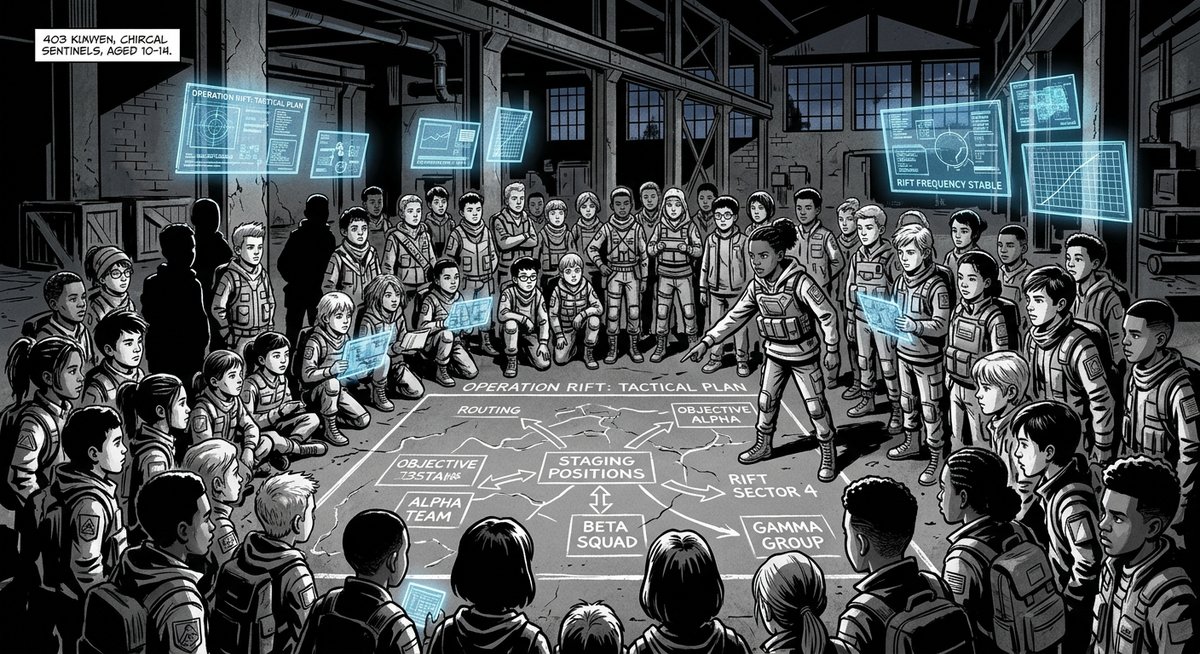
Jordan stood at the front of the largest crowd they had ever faced – and Jordan had faced Siege Nulls. Twelve Sentinel teams filled the abandoned auto shop at the intersection of four defended sectors. Forty-three kids, ranging from ten to fourteen, sitting on overturned crates, leaning against stripped-down engine blocks, crouched on the oil-stained concrete floor. Every surviving Sentinel team in the city, gathered in one place for the first time.
The holographic projector flickered on the wall behind Jordan. Hiro had built it from a gutted television, three salvage batteries, and what he described as “an unreasonable amount of copper wire.” The display showed the Architect’s plan in pale blue light: the Null rift, the breach points, the path to the rift’s core, and the Phase Two rebuild they needed to execute from inside the dimensional wound itself.
Jordan’s sketchbook was open in their hands. Their pencil was still. They had prepared remarks. They had written them down, crossed them out, rewritten them, and crossed them out again. Speaking to forty-three people was different from building for four. Jordan could construct a barricade under Siege Null fire without breaking a sweat. Standing in front of a crowd made their throat close.
The faces staring at them were tired. Dark circles under young eyes. Hands that should have been holding game controllers or basketball cards instead holding salvage tools and blueprint interfaces. Jordan recognized the exhaustion because they saw it every morning in the mirror. Four months of nightly combat aged a person in ways that did not show up on a birth certificate.
“The boundary layer operation proved that Phase Two works,” Hiro said from beside the projector, filling the silence that Jordan could not. “We rebuilt the boundary generator’s crystalline strands in twenty-two minutes. Our Core’s operational life is now projected at five years. But Phase Two was only a partial repair. The strands are rebuilt, but the fundamental rift – the wound between realities – remains open.”
“So we did surgery,” Kai said from the second row. The Ridgeline Builder sat with his arms crossed, his team arrayed behind him. “And the patient is still bleeding.”
“Correct.” Hiro pushed his glasses up. “Phase Three requires closing the wound from both sides simultaneously. Which means operators inside the rift.”
The warehouse erupted.
Voices crashed over each other. Some teams were on their feet. A Builder from the Eastwick remnant – a kid named Priya whose team had lost their Core two months ago – shouted that entering the rift was suicide. A Vanguard from the Hillcrest team, a broad-shouldered thirteen-year-old named Marcus, slammed his fist on a crate and said he was tired of defending and wanted to fight back. Two team leaders argued across the room in overlapping sentences that neither could hear.
Amara watched from Jordan’s left, bouncing on her toes, her eyes tracking the argument like a point guard reading a fast break. “They’re scared,” she murmured to Jordan. “Some of them want to be brave about it. Some of them want permission to say no.”
“Can you blame them?” Des said from Jordan’s right. She stood with her arms wrapped around herself, her grandmother’s chain glinting at her collarbone. The documentary narration was absent. This was too real for performance.
Jordan listened. They let the argument run until it began to loop – the same fears restated, the same objections recycled. Then they knelt.
The concrete was cold through their jeans. Jordan set the sketchbook aside and pulled a piece of chalk from their jacket pocket. The green army-surplus jacket, paint-stained and fraying at the cuffs. They began to draw on the warehouse floor.
The argument stuttered. Died. Forty-three kids watched a Builder draw.
The forward base took shape in white chalk against oil-dark concrete. Modular wall sections, interlocking like puzzle pieces. Each section self-reinforcing – it did not need adjacent sections to stand, but connecting sections multiplied their durability. The base could grow in any direction. If a section fell, the neighbors held. Jordan drew expansion options: north, south, vertical, inverted. The design adapted to any geometry because it was built to expect geometry that lied.
“It’s modular,” Jordan said, still drawing. Their voice was quiet. The warehouse was quieter. “Each section stands alone. Each section makes every other section stronger. That’s how we build. That’s how we fight.” The chalk scraped across the floor. “This is not a fortress. It is a bridge. We build it forward, module by module, into the rift. We carry stable physics with us. Wherever we place a module, the laws of our reality apply inside it.”
“And outside the modules?” Kai asked. He had moved closer. He was kneeling now, studying the connection points.
“Outside is the rift. Chaotic geometry. Shifting gravity. Raw Null physics.” Jordan looked up. “That is why we do not go alone.”
Suki, the Bayshore Vanguard who had lost her Core and her neighborhood, knelt beside the sketch. She traced a connection point with her finger. “These joints. They’re the same principle as the lattice strands you rebuilt in the boundary layer?”
“Drift crystal connections,” Jordan said. “Same material. Dual-reality properties. Inside the module, physics work. The Drift crystal creates a pocket of order in the chaos.”
“How much salvage?” Dev asked. The Bayshore Engineer was already calculating, his pencil moving across a notepad.
“Everything we have. Every team’s reserves, pooled.”
The warehouse went silent again. Pooling salvage meant trusting teams they had never fought beside. It meant giving up the reserves that kept their home defenses running. It meant going all-in on a plan drawn in chalk on a garage floor by a twelve-year-old.
Kai spoke first. “The connection points need foundation anchors. If the rift’s geometry shifts, the modules need to grab whatever surface is available – floor, wall, ceiling.”
“I was hoping you’d say that,” Jordan said. “The Ridgeline team’s foundation system. Can you adapt it?”
“Already thinking about it.”
Priya raised her hand. She was small, dark-eyed, and she had not stopped shaking since Eastwick fell. “How long do we have? Inside the rift. How long before we have to come home?”
Hiro answered. “Salvage batteries. Portable energy cells charged by our home Cores. Maximum operational life: approximately eight hours.”
“Eight hours,” Priya repeated. “To cross the rift, reach the core, and deploy Phase Two.”
“Phase Three,” Hiro corrected gently. “Phase Two is complete. This is Phase Three.”
“It does not matter what number it is, Hiro. Eight hours is not enough.”
“Then we build fast,” Amara said. She stepped forward, into the circle of kneeling Builders. She did not kneel. Amara never knelt. She stood over the chalk drawing like a general over a battlefield map. “Three nights from now. Two nights to prepare and train together. One night to push. Twelve teams. Forty-three operators. Every Sentinel in the city, building forward into enemy territory for the first time since this war started.”
The word settled over the warehouse. War. Nobody had called it that before. Defense. Siege. Holding the line. But Amara called it what it was.
“We have been playing defense for months,” Amara said. “Some of you, longer. And we are losing. Slowly, one Core at a time, one neighborhood at a time. Defense does not win this. Defense buys time. Offense buys a future.” She looked at Jordan. “Draw them the rest.”
Jordan drew. The rift’s core complex. The lock mechanism – a series of keystones that held the gateway closed, disassembled by the Source three centuries ago. The bilateral key design that would seal the gateway with operators on both sides, requiring agreement from both realities before the door could open. The plan that the Architect had conceived and four kids had refined during the hardest months of their lives.
The chalk scraped and whispered across the concrete. Jordan drew the path through the rift, annotated with estimated distances and module placement points. They drew the rift’s core complex as the Architect had described it – alien structures, ancient architecture, the lock mechanism at the center of everything. They drew the keystones that needed repositioning and the bilateral key that needed building.
One by one, the team leaders moved closer. They knelt around the chalk sketch. They began asking engineering questions instead of existential ones. How thick were the module walls? What was the salvage cost per section? Could the foundation anchors handle inverted gravity?
The questions were practical. The questions meant yes.
Kai from Ridgeline said yes first. Then Marcus from Hillcrest. Then Suki, who had lost everything and had nothing left to protect except the people in this room. Then Priya, shaking, terrified, her voice barely a whisper: “Eastwick says yes.”
Twelve teams. Forty-three kids. One chalk drawing on a garage floor.
The coalition agreed. The offensive launched in three nights.
The meeting broke into clusters – Builders comparing module designs, Vanguards arguing about combat formations, Engineers debating battery specifications. A Recon from the Northgate team unfolded a hand-drawn map of the city’s breach points, and three other Recons gathered around it, comparing notes. Two Engineers from different teams discovered they had independently invented the same salvage battery design and immediately began arguing about whose version was more efficient.
The warehouse hummed with the energy of forty-three kids who had been given too much responsibility and not enough sleep, choosing to carry more. Jordan watched the clusters form and felt something they had never felt at a tactical briefing: hope. Not confidence. Not certainty. Hope, which was smaller and more honest and somehow more powerful.
Jordan stood and wiped chalk dust from their palms. Their hands were shaking. Not from fear. From the weight of what they had just set in motion.
Des appeared at their elbow. Her face was tight. The documentary narration was back, but stripped of its usual flair – clipped, urgent, barely controlled. “Jordan. We need to talk. Privately.”
Jordan followed her to the warehouse’s back door. The night air was cold. The streetlights flickered – not transformed yet, not yet holographic projectors, but close. Sunset was an hour away.
“I was in the deep network during the meeting,” Des said. Her voice was low. Her eyes were dark and wide. “Running a sweep. Checking for the Source’s probe signal.”
“And?”
“The probe is gone. The Source pulled it back. All of it. The false network overlay Hiro built – the Source stopped mapping it. Stopped caring.” Des pressed her lips together. “Jordan. The Source was listening. Not to the network. To us. To this meeting. I felt it. Like a pressure against my ears. It heard the plan. It heard everything.”
Jordan’s chalk-dusted fingers went cold.
“It knows we’re coming,” Des said. “And it is already preparing.”