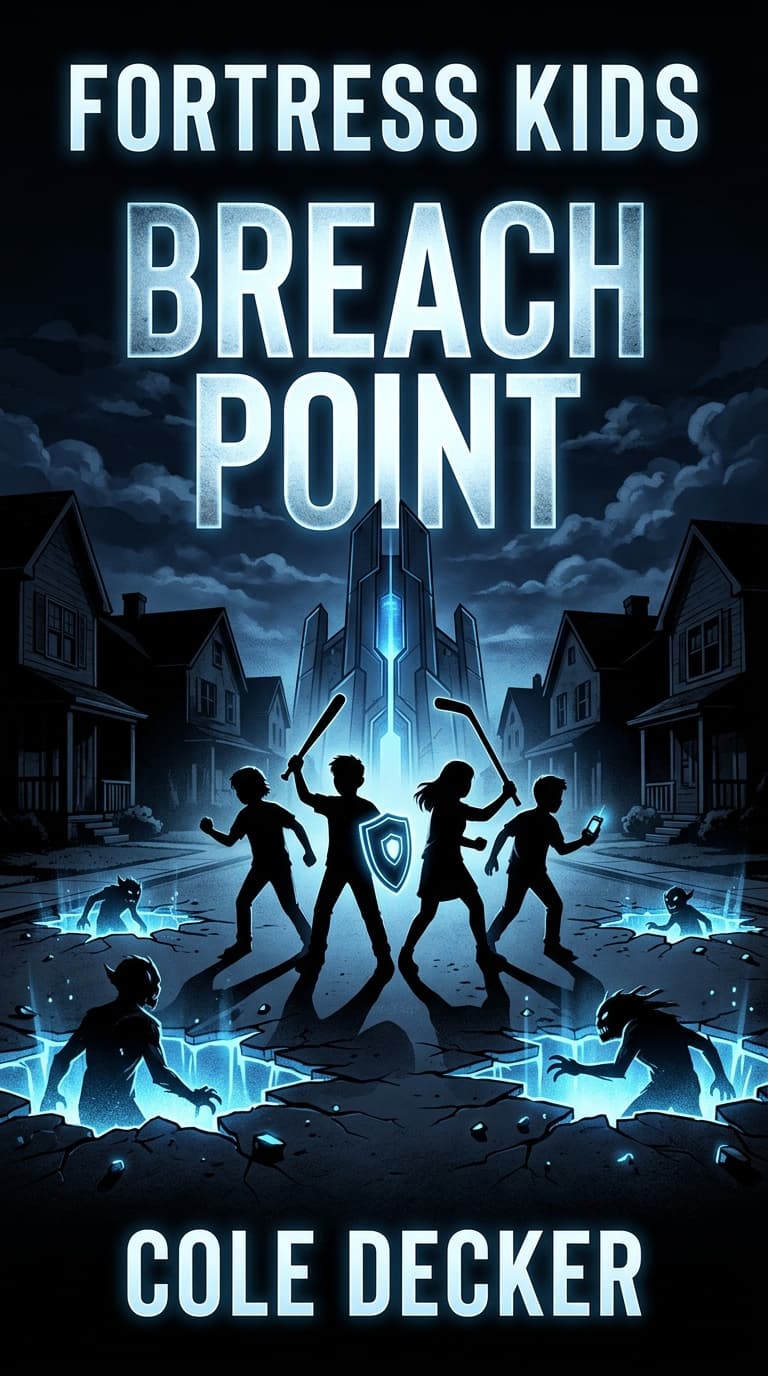
Chapter 1: Daylight Crawlers
Jordan’s pencil stopped moving.
The kitchen table was covered in the usual mess – sketchbook open to a half-finished blueprint, three colored pencils lined up by length, a glass of water that had been intended for drinking but was now cloudy with graphite dust from finger-washing. The afternoon sun came through the window at the angle Jordan liked best, casting long warm rectangles across the page. It was 5:47 PM. Thirteen minutes until sundown. Thirteen minutes of ordinary.
Then the light shifted wrong.
Not the gradual dimming of sunset. Not a cloud passing over the sun. Something else. A flicker, like reality blinked. The warm rectangles on the table stuttered, went cold for half a second, and came back altered – the edges sharper, the shadows deeper than they should have been at this hour.
Jordan looked up.
Through the kitchen window, across the street, three shapes materialized on the sidewalk.
Crawlers.
Jordan’s hand clenched around the pencil hard enough to crack the wood. They knew those shapes – the low, horizontal silhouettes, the way they moved like dark water flowing across pavement. They had fought hundreds of them. Maybe thousands. But always at night. Always in the transformed world. Always on the other side of the boundary that separated the battlefield from the ordinary neighborhood where people walked their dogs and checked their mailboxes and had no idea what happened between sundown and dawn.
These Crawlers were on the real sidewalk. In the real world. At 5:47 PM.
Mrs. Kowalski’s golden retriever saw them first. The dog had been sniffing a fire hydrant three yards from the point of materialization. Its ears flattened. It barked once – a sharp, panicked sound nothing like its usual lazy woofing – and bolted, yanking the leash so hard that Mrs. Kowalski stumbled sideways on the curb.
The Crawlers flowed across four feet of concrete. Where their bodies touched the curb, the surface dissolved. Not crumbled, not cracked – dissolved, the way it did inside the transformed zone during a wave. The concrete turned to nothing, leaving behind smooth, glassy edges that caught the afternoon light and reflected it back in colors that did not belong to this reality.
Ninety seconds. That was how long they lasted. Jordan counted every one of them, standing frozen at the kitchen window with a broken pencil in their fist. The Crawlers flickered, thinned, and vanished – evaporating like steam off hot pavement, leaving behind a silence that felt louder than any wave siren.
The dissolved curb did not come back.
Jordan grabbed their phone and called Amara. Three rings. Four. Pick up, pick up, pick up –
“What.”
“Get to my block. Now. The corner of Maple and Fourth.”
“Jordan, I’m in the middle of–”
“Crawlers just materialized outside my kitchen window. In the real world. Before sundown. And they dissolved a section of curb that is still dissolved. Amara. It did not revert.”
Silence on the line. The kind of silence that happened when Amara’s brain switched from basketball-practice mode to combat-assessment mode. Jordan could almost hear the gears shifting.
“Two minutes,” Amara said, and hung up.
Jordan was out the door in fifteen seconds. They crossed the street at a run, sketchbook already in hand by reflex – the same way Amara always had a basketball and Hiro always had a screwdriver. Some things were part of you.
The damaged curb was worse up close. A section roughly two feet long and eight inches wide had been erased. Not broken. Not chipped. Erased. The edges were glassy and smooth, exactly the way Null dissolution looked inside the arena – that terrifying clean removal of matter, as if the universe had been edited and the deleted content left a gap that nothing rushed in to fill. Jordan knelt beside it and touched the edge with one finger. Cold. Smooth. Final.
They opened the sketchbook and started drawing. The damage pattern. The exact shape of the void. The glassy texture of the edges. Their hand was unsteady, the lines wobbling in a way that would have embarrassed them in art class, but accuracy mattered more than style right now. This was evidence. This was a crack in everything they understood about how the Sentinel system worked.
Hiro arrived first, because Hiro always arrived when data existed. He appeared on his bike with a sample kit – a repurposed fishing tackle box filled with cotton swabs, small glass vials, a magnifying lens, and a UV flashlight he had built from a broken desk lamp. Without a word, he knelt beside Jordan and began scraping residue from the edges of the void.
“Dissolution pattern is consistent with standard Null contact erosion,” Hiro said, holding a swab up to the fading sunlight. The cotton tip shimmered with a faint iridescence that should not have been visible in the real world. “But the spectral signature is weaker. Approximately 40% of normal intensity. Like a diluted version of the transformation-zone effect.”
“Does that mean it’s less dangerous?” Jordan asked.
“It means the boundary was only partially permeable when the Crawlers materialized. They were operating at reduced capacity.” Hiro’s glasses caught the light as he tilted his head. “Which is the good news.”
“What’s the bad news?”
“The bad news is that anything came through at all. The boundary between the transformed zone and the real world should be absolute. If it’s degrading enough to allow materialization – even partial, even temporary – the containment system has a fundamental integrity problem.”
Des appeared from above. She dropped from the branch of a maple tree that Jordan was fairly certain she should not have been able to climb, landing in a crouch on the grass strip between the sidewalk and the street. Her cornrows were slightly disheveled, which meant she had been running a scout loop before the call came in.
“And here we observe the aftermath of an unprecedented breach event,” she said, her documentary voice tight around the edges in a way that Jordan had learned to recognize as barely-controlled alarm. “Three Null Crawlers, materializing in broad – well, twilight – visible to the naked civilian eye, performing standard dissolution on municipal infrastructure.” The narration cracked. She cleared her throat. “Jordan. This is bad.”
“Yeah.”
“This is really bad.”
“Yeah.”
“This is the kind of bad that has a Wikipedia article written about it in future tense.”
Amara arrived at a dead sprint from the east, basketball shorts flapping, and skidded to a stop at the edge of the dissolution zone. She stared at the void in the curb with the expression she usually reserved for opponents who played dirty.
“How long?” she asked.
“Ninety seconds of materialization,” Jordan said. “Then they faded.”
“And this?” Amara pointed at the glassy-edged hole in the concrete.
“Permanent. It has not reverted.”
Amara crouched and pressed her palm against the edge of the void. Jordan saw her Vanguard instinct at work – testing the surface, feeling for structural integrity, assessing whether the damage was spreading. After a moment, she stood.
“Team meeting. Hiro’s garage. Now.”
The garage was their unofficial war room. Hiro’s parents both worked second shift at the hospital, which meant the space was empty from 4 PM to midnight – a window that had become essential to the team’s operational schedule. One wall was covered in Hiro’s diagrams and technical readouts, printed on the back sides of his mother’s old nursing textbooks. A folding table held his laptop and three monitors rescued from a neighbor’s recycling bin. The floor was clear except for a stack of salvage-analysis reports and a mini fridge that contained exactly four juice boxes, one per team member, restocked daily by unspoken agreement.
Jordan laid the sketchbook on the table. The damage-pattern drawing stared up at them – a wound in the sidewalk rendered in shaky graphite.
“Let’s be clear about what just happened,” Jordan said. “Three Null Crawlers materialized in the real world, before sundown, before the transformation began. They caused dissolution damage that did not revert when they faded. This has never happened before.”
“Has it happened anywhere else in the network?” Amara asked.
Des already had her phone out. “I’m checking with the other teams now. Kai at Ridgeline, Sasha at Irongate, Ellis at Pinehurst – give me ten minutes.”
“While we wait.” Hiro connected his laptop to the largest monitor and pulled up the diagnostic data he had been compiling since the Core link stabilized after the Prospect Heights rebuild. Columns of numbers scrolled across the screen – Core integrity levels, boundary metrics, wave composition data from the last three nights. “I’ve been tracking an anomaly in the Core’s energy output for the past forty-eight hours. A fluctuation in the containment field that I initially attributed to the post-link stabilization process.”
“In words that aren’t a science paper?” Amara said.
“The boundary between the transformed zone and the real world is shaking. Not much. Not constantly. But periodically – about every six hours – there’s a tremor in the containment field. Like a drumhead vibrating after being struck.” Hiro adjusted his glasses. “I thought it was the Core adjusting to the new six-Core synchronization pattern. I was wrong.”
“What is it?” Jordan asked.
“Evidence of structural degradation. The boundary is weakening.”
The garage went quiet. The kind of quiet that had weight to it, the kind that pressed down on Jordan’s shoulders and made the sketchbook feel heavier in their hands.
“The boundary has always been absolute,” Jordan said slowly. “That’s the rule. The transformation happens, we fight in the transformed zone, dawn comes, everything reverts, and the real world never knows. If the boundary is degrading–”
“Then the rule is breaking,” Hiro finished.
Des looked up from her phone. Her face had lost its usual documentary composure. “Jordan. Someone posted a video.”
“What?”
“Of the Crawlers. Someone across the street from your house had their phone out. They recorded the whole thing – the materialization, the dissolution, Mrs. Kowalski’s dog running. They posted it to the neighborhood social media group.” Des held up her phone. The screen showed a shaky video with a caption that read: WHAT IS THIS??? “Forty-three comments and counting.”
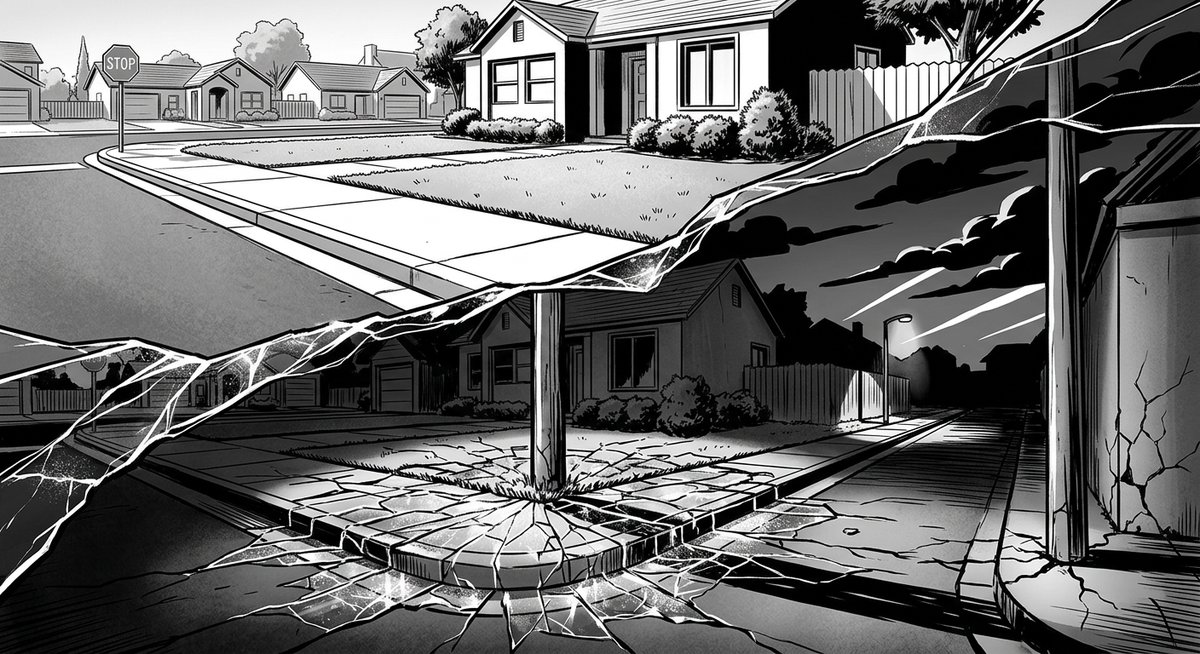
Jordan took the phone and scrolled through the comments. “What is that.” “Is this CGI?” “That looks like acid damage.” “I’m calling the police.” “Anyone else notice the weird shadow things near the school last week?” “This neighborhood is getting WEIRD.”
The team looked at each other across the table. The secret they had kept for fifteen nights – the Sentinel war, the Cores, the transformed neighborhood, the Null creatures that attacked between sundown and dawn – had always been protected by the boundary. By the absolute separation between their world and the battlefield. By the fact that nobody could see what they could see.
Amara spoke first. “We need a plan.”
“We need data,” Hiro said.
“We need both,” Jordan said. “And we need them before tomorrow evening, because if this happens again–”
“When,” Des said quietly. “Not if. When this happens again.”
Jordan looked at the video on Des’s phone. Forty-three comments. People asking questions nobody in the neighborhood could answer. Nobody except four kids who had spent fifteen nights defending a secret that was now leaking through the cracks in a barrier they did not know how to fix.
The sun had set. Through the garage window, the familiar shimmer of transformation rippled across the street. Night sixteen was beginning. And for the first time, Jordan was not sure the boundary between the battle and the world would hold until dawn.
Des pulled the phone back and refreshed the page. Her eyes widened.
“Fifty-seven comments now. And a local news station just asked the original poster for permission to share the video.”
The secret was cracking. Just like the boundary. And Jordan did not have a blueprint for either repair.